The conversation
The conversation focuses on MSU and municipal elections and explores how voting habits are formed, how campaigning can be made more accessible, and why many students feel disconnected from political systems. As the episode script explains, the goal is to help listeners understand “building voting habits, promoting campaigning, tackling disengagement and voter apathy among students, what one vote is going to do and why it matters, and how smaller communities understand voting.”
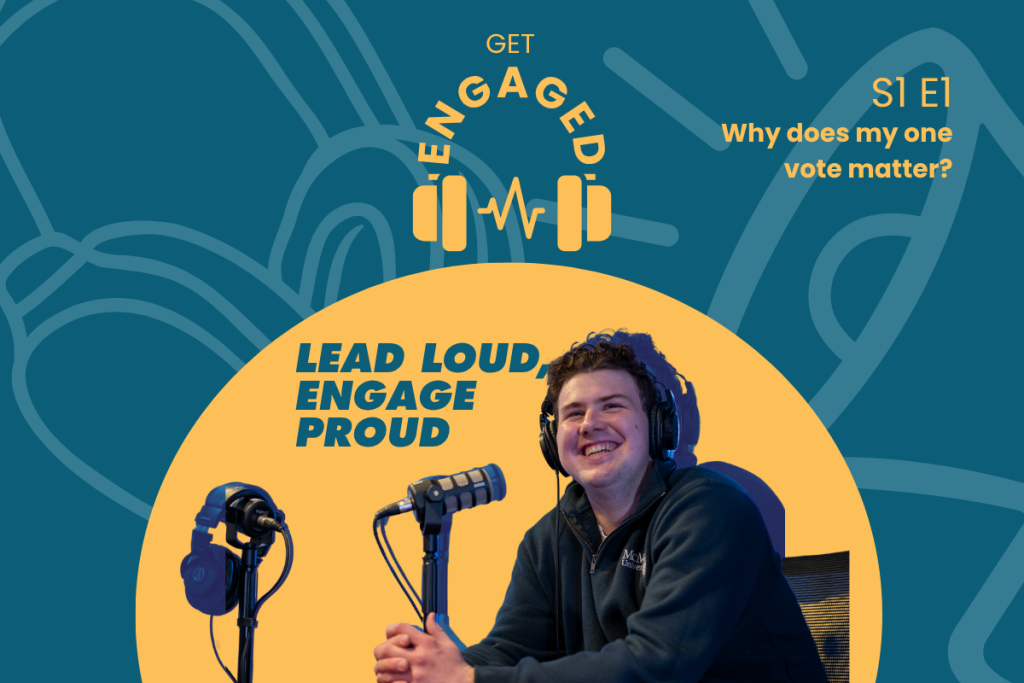
Host Sean Beckermann is joined by two guests who bring lived experience and national advocacy expertise. Sarah Rohleder, coordinator with the Canadian Council of Young Feminists and a long-time contributor to the Vote16 movement, shares insights from her work on youth enfranchisement and human rights. Dayle McKay, a Wilson College student and member of the Canadian Council of Young Feminists, offers perspective on youth engagement, Indigenous education, and the realities faced by young people navigating civic systems.
Full Transcript
00:00:00 Sean
All right, so this first episode will focus on the MSU municipal elections, the importance of small elections, and their impacts. So today we’re going to discuss building voting habits, promoting campaigning, tackling disengagement, and voter apathy among students. So, what one vote is going to do and why it matters, and how smaller communities understand voting.
00:00:22 Sean
So, guests, Sarah Rolater, coordinator from the Vote 16 Canadian Council of Young Feminists, and Dale McKay, a member of our podcast team and the Canadian Council of Young Feminists, join the conversation. So, without further ado, let’s get engaged in voting matters. All right, so it is my pleasure to meet you, Sarah, and thank you, Dale, for joining in the conversation. My name is Sean Beckerman. I’m a Wilson College student and your host for today’s episode. So please, if you don’t mind, take a moment to introduce yourselves.
00:00:52 Sarah
Yeah, I’m Sarah. I have worked with Vote16 for a number of years now since I was 16. So, it’s really exciting to be able to talk about it and work in a larger capacity. I work with Senator Marilee McPhedrin. I’m currently a graduate student at the University of
00:01:14 Sarah
Manitoba – doing a Masters of Human Rights. And yeah, I work with a lot of other organizations focusing on other issues. A lot of them are based on youth engagement. So being able to incorporate empowering youth through things like expanding voting rights is a very instrumental piece of that in terms of youth empowerment.
00:01:36 Sean
That’s awesome. Thank you so much for sharing. Dayle, the floor is yours.
00:01:40 Dayle
All right, thank you very much. So, my name is Dayle McKay, as you may know, and I am a first-year student with Wilson College at McMaster University and my engagement with the Canadian Council of Young Feminists.
00:01:55 Dayle
Sarah started, I would like to say around March of 2025. I stumbled upon it in a Google search and I saw that it was an amazing opportunity and I hit the ground running from there. A lot of my other research and passions have been around governance, democracy, electoral politics, and just being able to make sure youth have their voice as systemically and historically they do not know.
00:02:22 Sean
Awesome. Thank you so much for introducing yourself and telling us a little bit about you. So, without further ado, let’s jump right into things. So, for our first question here, for many young people, voting is tied to whether the system feels relevant to their lives. So, issues like housing, affordability, mental health, climate change, and education tend to come up again and again. So, Sarah, for you, when did you start feeling the need to do something about your voting habits and how did you execute that plan?
00:02:52 Sarah
Yeah, for me, that really started when I was 16 and I got introduced to the idea of expanding voting rights to 16- and 17-year-olds, because before I hadn’t really thought much about voting or about engaging with the government. How do you even go about doing that as a 16-year-old? And the more I thought about it and the more I did research, the more angry I got a little bit and frustrated because you’d do so much work. And I was watching other people in my high school doing work on in their communities on
00:03:22 Sarah
on climate change, doing service projects, learning. And I was also an Ethics Bowl, which teaches youth how to think critically about a lot of different issues. And I started to see those conversations change in terms of how people interact with government. And it just really was that disconnect. And so, seeing that and then realizing that a lot of us are making really important decisions now in terms of university, in terms of looking at
00:03:51 Sarah
student loans and issues that are very dear to a lot of us, like climate change, mental health, affordability and education, and not being able to have a say in our government. And that makes a lot of those decisions that impact our lives made me really want to start getting involved. And so, I joined the Canadian Council of Young Feminists and a lot of other issues and organizations as well to try and do something about that. And since then, I’ve been able to vote in different elections.
00:04:20 Sarah
I’ve noticed a lot with my other friends and classmates that disconnect between the governments and their own intentions of voting and how they go about doing that. And so, I think expanding voting rights just became a very central issue for me in terms of how we can get more youth involved in our governments and in those different conversations surrounding democracy and civic education and a lot of that.
00:04:48 Sean
No, awesome. I think that’s really powerful and I love everything that you shared with us. And so, I’ll turn it over to Dayle really quickly. Dayle, could you tell us more about your Vote 16 kind of involvement and what it really meant to you and how do you approach the disengagement among peers?
00:05:05 Dayle
Thank you for your question. So, as I mentioned before, I joined Vote 16 in about March or April of 2025. And one of the reasons I joined was
00:05:18 Dayle
because of the past federal election that we had last year. And a lot of my peers were turning 18. I was still 17 at the time, but seeing that disengagement, even in my own community of, oh, it’s fine, I don’t need to vote and things like that, as we see these really strong times going on, like when we talk about the political and economic state of the world, it’s really going on. And just
00:05:45 Dayle
people not wanting to engage or not knowing how to engage, I wanted to have an impact in changing that. And part of what I see in Vote 16 is that we have a lot of strong youth who really want to be engaged. In Ontario, we take civics and careers in grade 10 as a mandatory course, and you’re prepared and being taught about elections, about government, about everything.
00:06:11 Dayle
And it’s like you’re really prepared to do it then. And with the current state of media and news and communication in the world, we’re pretty knowledgeable on things that are going on. So, with my involvement with Vote 16, I’ve been able to reach out to Canadian or Ontario senators and people like that who have been able to help support Vote 16 or me trying to convince them and be like, it’s okay. You said pretty awesome. Just let us vote if other people don’t want to.
00:06:40 Dayle
We’ll do it. Things like that.
00:06:41 Sean
That’s awesome. Thank you so much for sharing. I think that’s really powerful. And so, for a little bit more of a topic focused question about what we’re discussing today, I’m sure that you know there’s a discussion circulating the bill, the Vote 16 Act. So, the bill proposed by Senator Mary Lou McVedran, who plans to extend the voting age to 16 across Canada. So, my question is for you, Sarah,
00:07:08 Sean
How do we explain this policy change to our youth, and why does my one vote matter?
00:07:15 Sarah
Yeah, so for your first question, Senator McPhedran’s bill, S-222, the Vote 16 Act, would lower or expand voting rights to ages 16 and 17, and then ages 14 and 15 can sign up to be a future elector. And a lot of reasons
00:07:36 Sarah
that this is so important is to empower youth, is to bridge that gap that I was talking before between government and youth. Because there is a large emphasis now on bringing young leaders into discussions of democracy, into governments. And we’ve been noticing that slow decline in democracy, slow decline in voter turnout. And the question is, how do we raise that? How do we get people excited about voting? How do we get them
00:08:05 Sarah
making educated decisions when they are voting. And a lot of that has come down to expanding voting rights. Having our young leaders already start voting, having them build that habit in high school where they have access to education, where they have time and room to learn how to vote.
00:08:24 Sarah
have Elections Canada come into their classroom and teach them that this is the voting process. Here’s how you make an educated vote. Here’s where you find a lot of those resources that can be really good. And rather than having ages 18 to 24 first start voting, when you’re in a state of turmoil, when you’re moving around maybe in a different province or in a different country, when your basic day-to-day life is so unpredictable, so having it
00:08:53 Sarah
being when you’re 16 or 17 allows you to have some of that predictability, allow you to build some of those habits and learn how to vote. And other countries have already lowered the voting age. One of the most recent examples is the United Kingdom, where they just expanded voting rights a few months ago, which is really exciting. And other countries like Scotland in their referendum a few years ago, I think in 2014,
00:09:23 Sarah
They had a huge burnout. Between the ages of 16 to 17, 75% of them turned out, which is a pretty amazing stat to look at. And other countries such as Austria and various in Latin America, such as Ecuador, Argentina, Cuba, Brazil, and Nicaragua have all expanded their voting rights to 16- and 17-year-olds. And the results have been pretty good. It hasn’t caused the collapse in democracy. It’s encouraged young people to get involved in their government.
00:09:53 Sarah
And coming to the second question, why does my one vote matter? It matters so much because when people stop voting, suddenly they lose their place in that democracy. They lose. I heard a talk yesterday and they focus a lot on how we as electors hold the balance of power in our hands. And if you don’t vote, you aren’t contributing to that balance of power. And
00:10:22 Sarah
Every vote matters, and we hear that a lot. But when they’re already engaging in a lot of important issues with their classmates too, that can inspire more engagement, inspire more thoughts and ideas, when you have it at that age, they learn how that vote matters, what their vote does at different levels of government, and why it’s so important to contribute every time an election pops up.
00:10:50 Sarah
And it’s, again, one of those habits that once they learn the importance of it, once they feel inspired and engaged with it, they can contribute to democracy and vote every time a future election comes up.
00:11:07 Sean
Awesome. That’s fantastic. So, while we’re talking about
00:11:10 Sean
the increase in younger people getting involved with voting and government and bridging that gap 10 years and where we see that increase. So, we’re going to start at 2023. In that year, we had a 10.5% turnout. So that was a very low engagement year. 2024, we saw a little bit of an increase at 16.4%. So that was about 4,500 students.
00:11:35 Sean
2025, a little bit more of an increase of 22.2%. That’s about 5,800 students. And then actually just recently for the year 2026, we had 30.2%.
00:11:48 Sean
percent of the undergraduate student body voted in this year’s election. So, this is a 36 percent increase in voter turnout from last year’s voter turnout. So, there’s a rising trend in civic participation at McMaster, but in what ways could we bolster youth voting behavior?
00:12:07 Sarah
Yeah, that’s a very good question. It’s amazing to see that rise in people voting. And I know from my experience that
00:12:15 Sarah
In my undergrad at the University of British Columbia, there’s been a huge push to get undergrads and students to vote, and it can be really hard. A lot of the time, people don’t know why is this important? Does my one vote matter? Does this actually influence any decisions that are made within the university? And I think a large way to bolster that is to make it relate to things people care about.
00:12:43 Sarah
show what their vote does, whether the decision is a yes or no, if it’s a referendum, or if it’s other issues too. In terms of presidential elections, making those events, advertising them more, which is obviously a thing people probably do already. But how do we make those, how do we bring those elections and make them seem more important?
00:13:10 Sarah
to those voters and in terms of what issues are talked about, having them vote on what issues they want discussed in events where different presidential candidates are participating in a debate. Just seeing how much people know about what the president does. What do their student councils do? A lot of people, I feel like, lose sight of that once they enter into university, when you have so many different things going on.
00:13:40 Sarah
A lot of people aren’t paying attention to what their student councils are doing. And I think having that be a part of when students come into the university, having it a part of their orientation, making it more a part of students’ lives, because I think especially for a lot of faculties that don’t do directly with politics, it can be very hard to find the time or the reason to seek out those answers or seek out what does my student union do for me.
00:14:09 Sarah
especially if you’re in something like science, when it seems very far from what you’re doing in day-to-day life, rather than if you’re in political science and your whole course looks at elections, making it and tying it more to either different student faculties, going to those classrooms and saying, this is what our student union does and this is how it impacts your faculty, relating those more to
00:14:34 Sarah
individual students and individual faculties or departments, I think, can have a large impact on it as well.
00:14:41 Sean
I think you raise a great point and I want to turn over to Dale really quick and just ask for these elections, MSU or for other small elections, if you will, how do we exchange knowledge or find that connection for youth to actually care about getting involved in voting?
00:15:00 Dayle
I think that is a great question. And I want to start it off by saying that I don’t believe that there’s anything like.
00:15:07 Dayle
such as a small election. I think that everything is big in its own way and has a bigger systemic change and impact on everything. These quote unquote small elections like the MSU, where we’re like electing our student union president, that student union president represents the entire university. And then they represent one of the major universities in all the universities in Ontario. And then they represent all the
00:15:37 Dayle
universities in Ontario to Canada, it has a really big, broad systemic impact. And how to get people to understand and care and really relating to what Sarah was saying about people in faculties for the government and governance and things like that really aren’t understood or seems really confusing because even when you are understanding that, it can be really confusing. Students care when they see themselves reflected in the candidates or the candidates
00:16:06 Dayle
goals or things like that. If you’re a student who’s really affected by the accessibility of your campus or if you’re like a person living in your city or your province who’s really affected by food costs, you’re going to want someone who is going to be addressing that issue or who can relate to you on that issue. And they want to understand what the role actually does.
00:16:30 Dayle
So, someone who doesn’t have a lot of background in government and things like that, they aren’t going to really understand what these roles do and not have an educated vote. They might even just vote for the person who has the prettiest color in their campaign. We don’t really know. So, they really just want to understand and have peer-to-peer education, like talking to your friends or looking online. The internet is our biggest tool when it comes to understanding democracy
00:17:00 Dayle
voting, things that are going in our own communities to understand and relate to one another.
00:17:05 Sean
So, you raised a really good point about how students can be affected when their vote doesn’t really count in such a way, because you said there is no such thing as a small election, but in some instances, there might be students or even older people who feel like their vote
00:17:26 Sean
doesn’t really matter. So, for both of you, Sarah, to start, can you please share a moment where you felt that your vote didn’t matter? And reflecting on that moment in time, how do you feel about that situation today?
00:17:41 Sarah
Yeah, so the first one that comes to mind is when I was at UBC and every year during our elections,
00:17:49 Sarah
they would have that question of should we increase tuition prices for the next school year? And it came up every school year and every year I voted no because everybody is going through hard times. A lot of people are struggling already to pay the tuition that is already there. And you don’t always see where that money, extra money is going. You don’t have a lot of those stats or reasons why we might need to increase it. And every year it would still go through and
00:18:18 Sarah
People, I don’t know whether it was people voting yes, but again, it’s in terms of that transparency. And so, every year the tuition would rise and thinking about already about different international students, different domestic students who are struggling to make ends meet plus paying tuition on top of it, it felt very sad and like my vote didn’t matter. And I still feel that way today and there might have been really good reasons for why the tuition went up.
00:18:48 Sarah
It was posed by the board of governors. So, we don’t always see where those decisions are being made. And that transparency is always very important. And it comes up in a lot of different contexts where transparency is vital for students and the public to know where these decisions are being made, as well as where that money is going. Because if you are paying it, you want to know what’s going on. Yeah, and that was
00:19:14 Sarah
That’s my always go-to thing for when I think about when I felt like my vote didn’t matter. Just because when you’re seeing and everybody you know might be voting the same way that you are, but then maybe there is that percentage of people who are voting differently than you. And being able to have those conversations and talk about and see those, how many people voted this way, how many people voted that way. It’s to know and feel why things ended up the way they did.
00:19:43 Sean
I think you point out a not controversial, but ongoing issue for universities too, is that every year there seems to be that little, small fee that gets added and you don’t really know what it’s for. Sometimes you might be giving $20 to a sports team that you didn’t even know your school had, right? So, there’s always those little moments where you have to sit back and think, why is this seeming to be the issue where it’s just constantly increasing?
00:20:08 Sean
But on another note, Dayle, what was that moment for you when you felt like your vote didn’t matter?
00:20:14 Sarah
So, because I am like nearly 18, new to federal, municipal and provincial elections, I haven’t had a lot of chance to vote and practice my democratic rights quite yet.
00:20:28 Dayle
But to change it up, I’d like to say a time where I wouldn’t have had, I wouldn’t have felt like my vote would matter.
00:20:36 Dayle
So, going back to what I said before about the federal election that we had in 2025, I didn’t really agree with some of the stances that both parties were bringing forward to the table.
00:20:47 Dayle
And something I think a lot about is like how we prioritize our two-party system in not just in federal elections, but in
00:20:57 Dayle
Honestly, a lot of elections, okay, what 2 candidates or what two things are like being the best right now?
00:21:04 Dayle
Okay, we have all these best ice cream flavors, but it’s chocolate versus vanilla.
00:21:08 Dayle
So, those are really the only two options.
00:21:11 Dayle
And it’s thinking a lot about would my vote even matter if I voted for butterscotch ice cream?
00:21:17 Dayle
Would it matter?
00:21:18 Dayle
So, thinking about that, I see voting now as habit building and signaling presence and
00:21:26 Dayle
opting out or not voting or being like, I’m the person I want to vote for, the thing I want to vote for won’t win anyways, I shouldn’t vote, isn’t really the mindset to have.
00:21:38 Dayle
It’s putting forward your vote.
00:21:41 Dayle
I mean, if nobody votes for butter smash ice cream is never going to win.
00:21:45 Dayle
So it’s all about habit building, just putting forward your thoughts, putting forward what you want to, because that’s what democracy and participation is all about.
00:21:55 Dayle
Yeah.
00:21:56 Dayle
Voting isn’t just about winning.
00:21:58 Dayle
It’s about showing up with consistency.
00:22:02 Sean
I think that’s actually a great segue to my next question for both of you is what could the older generation gain from youth votes?
00:22:11 Sean
And Sarah, please just like to start.
00:22:14 Sarah
Yeah, this is a very good question.
00:22:17 Sarah
And
00:22:18 Sarah
I think it also goes both ways in terms of what can the younger generation gain from learning about from the older generation and maybe why the way they did, why their votes maybe shifted the way they did.
00:22:30 Sarah
But in terms of older generation can gain from youth votes, I think youth are bringing in a lot of new perspectives.
00:22:37 Sarah
They’ve been taught in a very different education system than a lot of older generations have.
00:22:41 Sarah
They’re learning about indigenous issues, they’re learning about climate change, about
00:22:46 Sarah
They may never be able to own a house.
00:22:48 Sarah
Affordability issues.
00:22:50 Sarah
They’re being raised in a very different time and coming at it with a lot of different ideas.
00:22:54 Sarah
And there’s been a lot of rise in schools as well with things like the ethics bowl, where they think about issues in a very different way that a lot of older generations may have come at it through a debate.
00:23:04 Sarah
And so, they’re coming out with this really well-rounded perspective, a lot of youth anyway.
00:23:11 Sarah
And I think that’s a very valuable thing to have in voting now is that well-rounded perspective.
00:23:19 Sarah
It adds a lot to democracy in terms of maybe what questions are being asked during debates by voters.
00:23:28 Sarah
And having a youth member at debates asking
00:23:32 Sarah
I can vote now.
00:23:34 Sarah
Here’s my question about this issue that’s very important for me as a 16-year-old who’s just voting for the first time but has a lot of ideas and concerns about my future because I am going to be in this world for hopefully a very long time for the next.
00:23:50 Sarah
And so, thinking about what they bring, the causes that they have, the concerns that they have, the causes that they’re inspired
00:24:00 Sarah
by and to do something about, I think that they can add a very well-rounded, informed vote to add to the ones that a lot of older generations also add.
00:24:14 Sean
Thank you so much.
00:24:15 Sean
And then Dayle, what is your perspective?
00:24:18 Sean
What do you think the older generation can gain from youth votes and as Sarah pointed out, vice versa?
00:24:26 Dayle
So, to start off, something loud I thought about while Sarah was speaking was, we learn history, so we don’t repeat the past.
00:24:35 Dayle
And I think that’s something very vice versa that we can exchange between the younger voters and the older voters.
00:24:43 Dayle
They have their own lived experience on issues that have gone on and they can see the patterns in what has happened through their time and what they’ve been voting for, their experiences and things like that.
00:24:56 Dayle
But as a younger generation, we can see that like broader things that will happen or new things that are coming in and the globalization of the world that we’re seeing and everyone being interconnected.
00:25:09 Dayle
We can find new solutions to issues that have gone on for lots of time.
00:25:14 Dayle
And it’s a lot about interchanging your education and more so collaboration towards the older generation and the younger generation.
00:25:24 Dayle
It’s not okay, like they’re older, like their vote doesn’t matter.
00:25:28 Dayle
They still have a lot of education and knowledge on what they have learned and experienced that can help set up our future, so we don’t repeat the past.
00:25:38 Dayle
But with youth, they have these issues that are affecting them in the present.
00:25:45 Dayle
A lot of older things will be like, oh, that never happened to me as a youth.
00:25:49 Dayle
What’s happening now?
00:25:50 Dayle
So, what are we going to do about it?
00:25:53 Dayle
And we should, it’s definitely a collaborative conversation that needs to happen for both parties to really understand.
00:26:01 Dayle
I don’t think there’s the one side to it.
00:26:05 Sean
I completely agree.
00:26:06 Sean
I think that’s a very strong point that you present.
00:26:09 Sean
As I understand it, I know it’s already 4.33.
00:26:12 Sean
Is it maybe best if we skip to our closing questions and wrap things up for today?
00:26:17 Sean
Sarah, I believe that there’s something you would like to share with all our listeners.
00:26:21 Sarah
Yeah, so if you are feeling inspired about expanding voting rights to 16- and 17-year-olds, we have a petition up on change.org that everybody is welcome to sign.
00:26:33 Sarah
It lists a lot of the issues why this is so important on the petition as well if you need a little bit more coaxing.
00:26:40 Sarah
And then if you also want to take more direct action, you can also e-mail your senators about Bill S-222 and explain why they should support the bill and why you do as well, why this is important for our democracy and why this is important for our future as well.
00:26:55 Sarah
And then you can also discuss it in your classrooms, with your classmates, with your family or friends.
00:27:01 Sarah
raise that debate, raise that ethics question if you want, and get other people’s thoughts on it as well and give your own opinions because it’s something that needs to be discussed in terms of empowering more youth and engaging them in our democracy and in our government.
00:27:17 Sean
Perfect.
00:27:17 Sean
Thank you so much.
00:27:18 Sean
And then
00:27:19 Sean
One last really cool and fun question for both you and Dayle.
00:27:23 Sean
Describe your perfect vote in one sentence.
00:27:26 Sean
So that could be something feel, hear, or smell while you make that vote.
00:27:30 Sean
What would that be for you, Sarah?
00:27:32 Sarah
I’m going to be optimistic and say I walk out feeling hopeful.
00:27:38 Sean
That’s awesome.
00:27:39 Sean
I love that.
00:27:40 Sean
And Dayle.
00:27:41 Dayle
So, trying to make up a really perfect analogy, I know that we have
00:27:47 Dayle
trying to sink of something.
00:27:49 Dayle
My perfect vote feels ordinary but powerful.
00:27:53 Dayle
If I were to have a physical ballot as soon as I put it in the box, it feels powerful and showing up when no one’s watching and just knowing my voice counts, knowing that butterscotch ice cream might have a chance.
00:28:10 Sean
That’s awesome.
00:28:11 Sean
So it’s important to mention though, the conversation does not end here.
00:28:15 Sean
So, if you’re curious,
00:28:17 Sean
Start learning more by visiting Vote 16’s website to see how young people are working to expand voting rights.
00:28:23 Sean
As well, follow or support the youth-led organizations doing this work.
00:28:27 Sean
And have conversations about voting and power in your own circles.
00:28:31 Sean
So, thank you both for sharing your take on why voting matters.
00:28:36 Sean
If there’s anything that you would like to leave us with today, please do.
00:28:40 Sean
And then we will wrap up things for today.
00:28:46 Dayle
To leave it off really nice is I want to say that voting isn’t about believing in that the system is perfect.
00:28:54 Dayle
It’s about refusing to disappear from it.
00:28:56 Dayle
Showing up consistently is how change starts.
00:29:00 Sean
Thank you so much.
00:29:01 Sean
And Sarah?
00:29:02 Sarah
For me, it’s something similar that if you decide not to vote, millions of people decide not to vote, and then you’re left with so many votes that aren’t counted that could have done something in an election.
00:29:16 Sarah
Where some ridings are decided by only 50 votes, if more people had voted, it would be a greater engagement in democracy, but then also more of a running.
00:29:28 Sarah
By not voting, you’re letting that balance of power slip a little bit.
00:29:33 Sarah
We all have a vote, and we all have the right to vote and express our opinions and our ideas.
00:29:41 Sarah
So, make sure you vote whenever you can, wherever you can.
00:29:46 Sean
All right, thank you so much, Sarah and Dayle.
00:29:48 Sean
For those that are listening, please follow and listen to our podcast on McMaster’s Campus Radio, CFMU, MacBlog, McMaster, Spotify.
00:29:58 Sean
So, please share that for those that haven’t had a chance to listen to us quite yet.
00:30:02 Sean
All the details can be found on our website, wilsoncollege.mcmaster.ca.
00:30:07 Sean
So, to close off today, lead loud and engage proud.
Vote16 Canada and the International Movement
Vote16 Canada is a national youth-led organization working to lower the legal voting age from 18 to 16. The movement argues that sixteen and seventeen-year-olds already demonstrate the maturity, responsibility, and civic awareness needed to participate in elections. Many young people work part-time, pay taxes on their income, and are directly affected by policies that shape their futures. The campaign positions youth enfranchisement as a practical and evidence-based step toward a more inclusive democracy.
The federal Vote 16 Act (Bill S-222) was defeated at second reading in the Senate, but it sparked national conversation and helped build momentum for future advocacy. With the federal pathway stalled, Vote16 Canada has shifted its strategy to municipal governments, school boards, and constitutional challenges.
New Canadian Frontlines
Across Canada, local governments are becoming the testing grounds for youth voting. These local efforts show that youth enfranchisement is possible even when federal legislation stalls.
- Toronto extended voting rights to roughly fifty thousand sixteen and seventeen-year-olds for neighbourhood-level planning and policy polls.
- Vancouver has debated a motion asking the provincial government to amend the Vancouver Charter to allow youth to vote in municipal elections.
- Ontario is home to an active Charter challenge arguing that the current federal voting age violates the Canadian Charter of Rights and Freedoms.
Why Sixteen?
Supporters of Vote16 emphasize several core points.
- Habit formation: Voting while still living at home and attending high school helps build long-term voter turnout.
- Tax fairness: Many teenagers pay taxes on employment income. Supporters argue that taxation without representation is inconsistent with democratic values.
- Representation: Youth advocates highlight that lowering the voting age brings crucial Indigenous and diverse youth voices into governance.
Global Momentum

Lowering the voting age is a growing international trend. Seventeen countries, including Germany, Austria, and Scotland, already allow voting at sixteen. The United Kingdom has introduced legislation to lower its voting age for general elections. These examples provide strong evidence that youth voting can strengthen civic participation and improve long-term democratic engagement. International research also shows a “trickle up” effect. When teenagers vote while living at home, political conversations increase among parents and older family members. This raises turnout across entire households and strengthens civic culture.