1942:
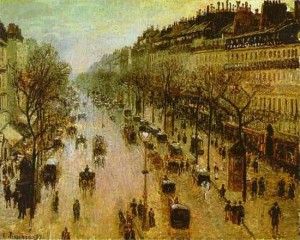
[123] Still without glasses, so spoiled myself loafing. Nobody can tell me impressionist painting of the Pissaro type is myopic. I find that when outlines are fuzzy I become very sensitive to splashes of color.
1942:
[123] Still without glasses, so spoiled myself loafing. Nobody can tell me impressionist painting of the Pissaro type is myopic. I find that when outlines are fuzzy I become very sensitive to splashes of color.

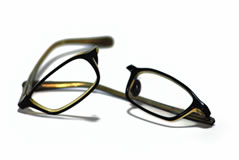
1942:Glasses broken, but somehow life goes on.
[122] Staggered around without my glasses trying to read Morris’ Early Romances, which I got yesterday morning from Britnell’s along with several other second-hand Everymans for my new course. Harold & parents dropped in with the Lambert kids. Jessica goes to Trinity – a very sweet kid as far as I could see, which of course wasn’t very far.
Sorry that we were down all weekend. Our technical advisor gave us a technical explanation which amounts to this: the problem is fixed.
We’ll try to make up for lost time as quickly as we can.
1942:
[121] Helen down with a cold. Bust my glasses for the first time in eight years, which vexed me, as Pepys would say.
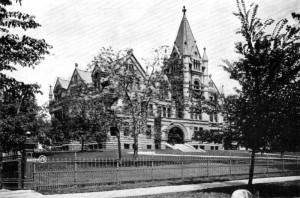
Victoria College, back in the day
1942:
[120] College creeping back: for the first time I don’t want to see it open. I didn’t get enough Blake done. Faculty reunion dinner tonight, very dull. There’s going to be occupational therapy for the girl patriots, there’s a lot of pro-Vichy propaganda in Quebec, arts colleges are now being closed up right away – ho hum. Havelock back – his Socrates will run to two volumes.
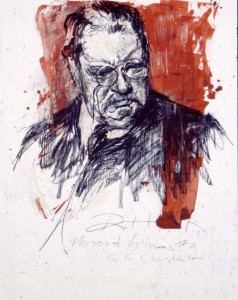
Clayton Chrusch comments on Russell’s post earlier today:
Was Frye being unfair or am I completely naive?
Chesterton wanted to give his audience clear answers and Frye did not. Frye witheld answers because he didn’t want his audience to be stuck with them. Chesterton wanted to give his audience answers, not because he wanted his audience stuck with them and not because he considered himself the greatest authority on anything and not because he considered his own views to be in their final state, but because he thought that, if people were honest, the truth could take care of itself, and that a clear and honest answer backed by reason is as likely to yield truth through participation in a dialectic process as a reticent answer.
Russell responds:
Clayton, I think (and have attempted to argue in an essay a few years ago) that Frye did not see the positive side of the appeal of tradition and orthodoxy in matters of religious belief. Perhaps in part it was his Methodist upbringing, perhaps the spectacle of Catholic fascism, which he comments on several times, but he doesn’t seem to have had much sense of what Chesterton terms “The Romance of Orthodoxy.”
Jean O’Grady has written an interesting account of Frye’s relationship with the United Church of Canada, showing that he didn’t find it much easier to get on with it than with the Catholic Church. She writes “If one searches the diaries and notebooks for evidence of Frye’s attitude to his clerical role, one may well be startled by the negativity of his remarks” (Frye and the Word, p. 176).
1942: Still thinking about the movies as a form of popular entertainment.
[119] Another point about ‘what the public wants’ is that there isn’t anywhere else for a young couple to go. Hence out of sheer self-respect they can’t allow themselves to be bored. The dollar they paid to get in is a hole in their expense money: they’re not to walk out of it & leave the dollar behind. Besides, what else are they to do with their evening, read Shakespeare? There’s no use telling them to practice the art of boredom & improve their taste. The situation is there and nobody can do anything about it – I guess that’s got it.
A nice observation from Peter Yan:
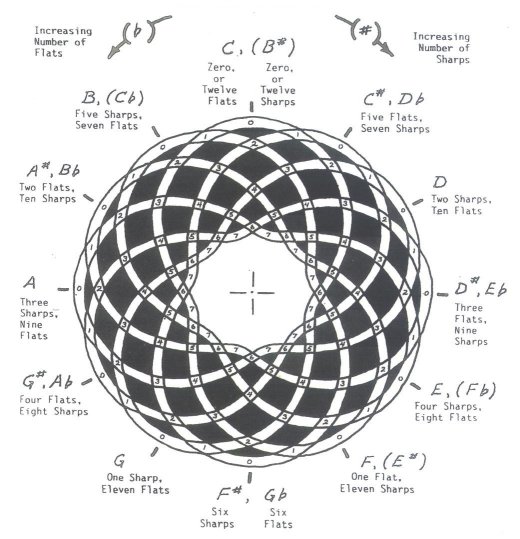
Frye used the musical term mode to describe and order the character’s power in relation to us readers; and how these modes change over time, giving us, in the first chapter of Anatomy of Criticism, how a genuine historical method should work in literature.
What is curious is that the ultimate myth/genre for Frye was the Quest Romance, which he assigned the key signature of C, the key which all keys can be translated into, and the key which all modes musical take off from. The Quest Romance myth is the mode which includes all the other myths in its epic form.
httpv://www.youtube.com/watch?v=HyJAytr1ebc
1942: Frye’s other extra-curricular pre-occupation of the time: movie music. [Above, the kind of thing that Frye is presumably talking about — the closing sequence from Citizen Kane. Spoiler Alert! “Rosebud” is revealed.]
[117] Ideas for article on movie music. Orson Welles’ incessant woo-woo noises, a full series of drum rolls & trombones slithering from solemn burp to gloomy blop. Most incidental music is just ‘flourish,’ ‘sennet,’ ‘exeunt with a dead march’ stuff, a bag of tricks ‘sound effects,’ in short. Oscar Levant describes the sweep (Aug. 29) & feels that the producer always wants tutti, like the parvenu who wouldn’t have any second violins in his orchestra. He quotes a Russian film (Shostakovich) opening with a lone piccolo, followed by a flute. This indicates a lack of enterprise in experimenting with timbre. Hollywood can’t use woodwinds: they can’t shiver their timbers: only brass. The piano’s very effective percussive tone they leave out: they overdo harps & leave out tom-toms & gongs ever for horror films. Conventional orchestra background for everything: no regrouping. Motto from Ecclesiasticus. Nobody listens, so no leitmotif, an obvious point, one would think. Quotation, of course, and plagiarism. Uniformly heaving scoring: all harmonic tricks & general air of having found the lost chord, mostly the dominant discords. Why not long stretches of scenery & music for real drama, towards an operatic movie? Because nobody listens. This all the more essential as real music has dropped behind. There’s no amusing popular song: just bawling & nasal honks. Swing is stuck on a treadmill of rhythm, even Duke Ellington. Might recall ‘motion picture moods’ of Rapee as showing plagiarism bias. Often more effective. Farmyard Symphony vs. Fantasia, use of Beethoven’s Pastoral. Even good tricks, high pedal-point on Snow White, 19th c. What I mean by vocal music is that musical comedies can’t last. Songs are painful to photograph, singers even more so, & the camera is too relentless in its pursuit: musical comedy plots are pretty fragile…Need more Gershwins? Might explain about ‘syncopation’ of jazz. If chromatic harmony is played out the movie is the place for new experiments, not the concert hall. Of course there is a good deal going on, the train-boat sequence of The Reluctant Dragon. Oh, we’re getting there: that should be enough for a necessarily rather vague & ill-informed article. After all, I don’t know anything about montages or pan shots or fadeins or the rest of the patter.