
A reminder that Earth Hour commences today at 8.30 pm local time.
A reminder that Earth Hour commences today at 8.30 pm local time.
httpv://www.youtube.com/watch?v=vXFi7AdhhGk
Tim Lee, possibly the only standup comedian with a PhD, does a bit on PowerPoints with PowerPoints. Worth seeing. Worth showing to your students.

Frye is cited in a couple of blogs today, for very different purposes, reminding us just how broad and generous that intellect of his is.
“Junk Politics,” in Bill Toten’s Weblog, and “The Thriller, A Consideration,” in The Denver Bibliophile.
httpv://www.youtube.com/watch?v=TauWURuddFI
Sonata no. 29 (“Hammerklavier”), Largo e Allegro Risoluto. Alfred Brendel, piano.
On this date in 1827 Beethoven died.
Here’s the 19 year old Frye on Beethoven:
Beethoven’s attack on the sonata form is more subtle [than Wagner]. Broadly speaking, it centres around the pictorial approach, and, hence, the compression and economy of the Mozartian sonata disappears, and the sonata takes on a greatly enlarged aspect. The speed no longer swings about a balance, but the various movements (Beethoven expanded the three‑movement form to a four‑movement one) are rhythmically contrasted. The middle theme of Mozart is expanded to a tremendous development section*a purely pictorial idea which analyses every implication of the given themes and holds them up to the light, as it were. A similar impulse leads Beethoven to develop the coda. The egocentricity of his later forms is, if often exaggerated, nonetheless present, and it can hardly be altogether an accident that the greatest of romantic musicians became deaf in his later years, whereby the individual concentration power would be so much augmented. There is in Beethoven, however, a good deal of the will‑to‑power spirit as well. In his later works he is no longer content merely with a spatial attack on the sonata form; he must probe deeper and analyse the fundamental secrets of the time‑problems in his art form. In consequence, the two works of his last period which are on perhaps the largest scale deal first of all with an exhaustive and distinctly pessimistic and despairing analysis of the sonata form, ending in a slow movement, and followed by a terrific burst of energy which tears to pieces, in the one case the fugue, in the other the oratorio. The two works in question are Hammerclavier Sonata, op. 106, and the Choral Symphony. (Student Essays)
(Thanks to Bob Denham for the quote.)
Finale of the 9th Symphony after the jump.
httpv://www.youtube.com/watch?v=XMrdhgWR9Zk
On this date in 1918 Claude Debussy died.
From the first entry of Frye’s 1942 diary, July 12th;
The French have consistently ignored the great forms, the sonata and the fugue, and have stuck to dainty descriptive pieces not to be taken too seriously. It seems to be an outlet for their crotch-bound paralytically caesured poetry. The pictorial tendency, often with a dance basis, is so persistent it should be worked out in some detail… The French are not a rhythmically moving race — a Celtic-Latin alloy… The highlights of a musical history would probably be Couperin–Rameau fanciful titles, with some of Landowska‘s notes (lunatic but interesting). The attack on opera centring on the Gluck and the Tannhauser fights the impossibility of producing music while pretending to be a Roman (Revolution: Cherubini & Napolean were both Italians): the 19th c. partition into the Provencal, and Belgian and a Pole (Frank is purely Teutonic and Chopin‘s music is entirely pictorial. His non-committal titles are a pose: one doesn’t expect any other music to follow his Preludes. There’s a closer link between Chopin and Debussy than one would at first think): the opera bouffe parodies of the Faust type: revival of the Rameau tradition with Debussy & Ravel: Saint-Saen‘s last-war journal. Do the French hate music? Why is there no lust of the flesh & pride of the eyes in it? no Renoir or Boucher or Hugo even? I’m getting cultural dysentery again. Hangnail is an incorrect form of angnail, a clear sense of false etymology. (CW, 8, 4-5)
There are actual recordings by Debussy, but I wasn’t able to find one I could post. However, above is a piano roll made by Debussy of “Golliwog’s Cakewalk“.

Two student bloggers produced brief posts yesterday on The Educated Imagination‘s “Giants in Time“. Either it’s a remarkable coincidence, or they’re both working through the same academic timetable. Either way, it’s nice to see that young students especially continue to engage this work.
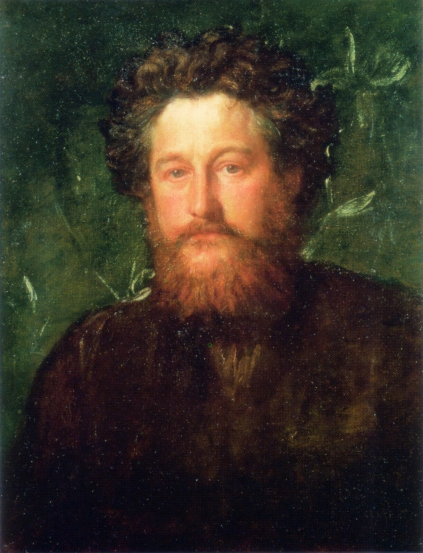
Portrait of William Morris, by George Frederic Watts, 1870
Today is William Morris‘s birthday. Morris is a touchstone for Frye when it comes to romance. Here’s a sample from The Secular Scripture, “The Recovery of Myth“:
William Morris is an example of a writer whose attitude to the past is one of creative repetition rather than of return. Morris admired the Middle Ages to the point of fixation, and yet the social reference of his medievalism is quite different from that of Carlyle, or even Ruskin, who so strongly influenced him. According to Morris, the Middle Ages appears right side up, so to speak, when we see it as a creation of artists, not in its reflected or projected form as a hierarchy: when we realize that the genuine creators of medieval culture were the the builders and painters and romancers, not the warriors or the priests. For him, the fourteenth century was the time when, with the Peasants’ Revolt, something like a genuine proletariat appeared on the social scene, it’s political attitude expressed in John Ball’s question, where were the “gentlemen” in the working society of Adam and Eve? In News from Nowhere, the “dream of John Ball” (the title of another work of Morris) comes true: the people in that happy future world are an equal society of creative workers. They have not returned to the fourteenth century: they have turned it inside out.
A selection of Morris’s wallpaper after the jump.
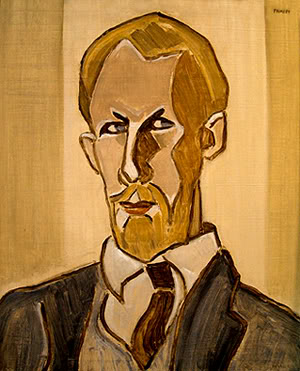
Portrait of Francis Sharshott, by Barker Fairley
Here is a link to Francis Sparshott’s lively and engaging “Frye in Place” (PDF). According to Bob Denham’s Annotated Bibliography, this essay was published in Canadian Literature 83 (Winter 1979): 143-155.
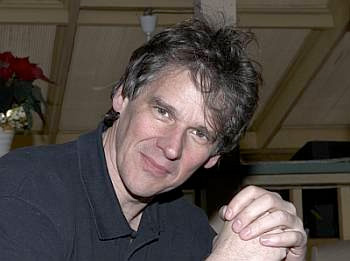
Canadian science fiction writer and marine biologist Peter Watts
Peter Watts’s “crime” is detailed in a post by Cory Doctorow at Boing Boing:
Canadian sf writer Peter Watts was convicted of obstruction for getting out of his car at a US Border crossing and asking what was going on, then not complying fast enough when he was told to get back in the car. He faces up to two years in jail.
********
That’s apparently the statute: if you don’t comply fast enough with a customs officer, he can beat you, gas you, jail you and then imprison you for two years. This isn’t about safety, it isn’t about security, it isn’t about the rule of law.
It’s about obedience.
Authoritarianism is a disease of the mind. It criminalizes the act of asking “why?” It is the obedience-sickness that turns good people into perpetrators and victims of atrocities great and small.
I will link to mainstream media outlets when they get the story right! They have not so far. They are reporting that Watts was convicted of assualt. He was not, according to a juror quoted at length in the Boing Boing post. (Once again, the new media represented by the blogosphere surpasses the old media in getting both the story and its implications right.)
There are serious allegations that Watts was assaulted by border guards and talk of the possibility of civil action against them. In the meantime, Watts faces two years in prison.
Watts’s version of events here.