Author Archives: Michael Happy

Freud and Frye

freud

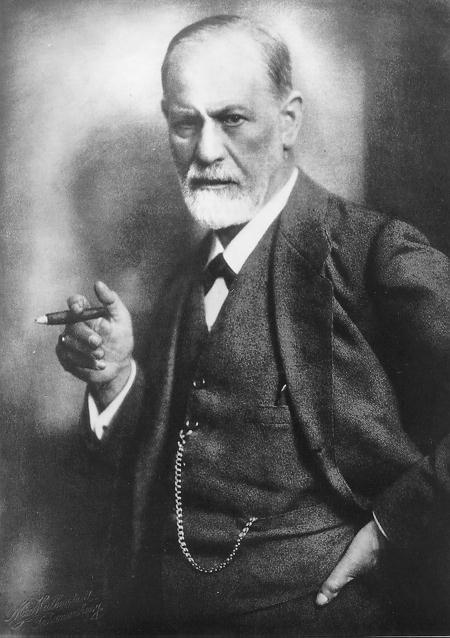
I’ll leave it to those who know Freud better than I do, but in response to Merv’s post below, it seems to me that Frye freely adopts Freud in Anatomy: “ritual” and “dream” and “displacement” are all Freudian concepts, aren’t they?  It may be that he is more “liberal” than Freud, but Frye, as always, is generous in adapting the best work of others.  Hell, he makes Spengler relevant in  a way that just about no one else could.

Is a cigar sometimes just a cigar?

Today in the Frye Diaries, 15 September

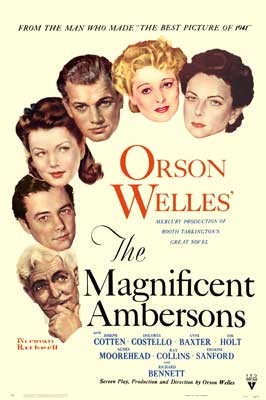
Magnificent_ambersons_movieposter

1942:One of Frye’s favorite extra-curricular pre-occupations of the time: movies.

[115] Called for Helen and took her to see “The Magnificent Ambersons,” highly recommended by some people including Eleanor [Godfrey], but I found it a blowsy and turgid piece of Byrony. I’ve been writing out a paper on William Bryd, which is taking too much time but seems to be inspired. If I’m going to do movie articles I should get Leo Rosten’s book on Hollywood: he’s the Leonard Q. Ross of Hyman Kaplan. Peter Fisher was in this morning with a hint he might be going overseas. Discussed German-Russian war as based on Rajas-Tamas clash of Albion & millennial ideals: both proximate and apocalyptics.

[Bob Denham’s note (107): “In Vedantic philosophy, two of the three qualities of prakriti (nature of primordial matter): rajas refers to activity, striving, or the force that can overcome indolence; tamas, to the dull, passive forces of nature manifest in darkness and ignorance.”]

Today in the Frye Diaries, 14 September

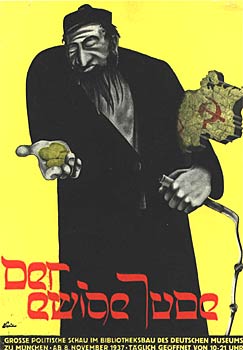
nazi_propaganda_eternal_jew

1942:Frye scoffs at “Senior Common Room” anti-Semitism, which, unfortunately, seems to have been common enough at the time.

[113] I’d like to do a New Yorker type story with echoes from a club like our S.C.R [Senior Common Room]. Krating: “…you see it isn’t the Espiani Jew, the real Jews, that are the trouble; it’s the Polish kind that cause…” “So when the inspectors arrived they found the coal all stacked up in the bathtub. You see, you just can’t…”

[Bob Denham’s note (103): “Apparently a reference to the controversial depiction of the Jews by Alfonso de Espina (15th century), the chief originator of the Spanish Inquisition. Alan Mendelson notes that NF is ridiculing Krating for expressing a common prejudice at the time – that the Sephardic Jews are acceptable because they are good candidates for assimilation and converstion, but the more recent immigrant Jews from Eastern Europe are not, because they are ignorant of ‘our ways.’ The prejudice was common also in England at the time. Mendelson points out that George Grant also refers to ‘the coal in the bathtub’ example in one of his own journal entries at about the same time (28 October 1942).”]

Below is a clip from the notorious Nazi propaganda film, Der ewige Jude (German with English subtitles).

httpv://www.youtube.com/watch?v=2OxTmH5KGGo

Frye and Logic

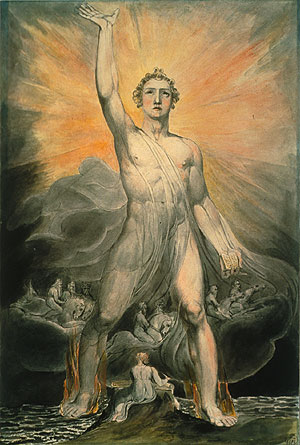
blake-angel-of-the-revelation

Blake's Angel of Revelation

Over the last couple of days the Comments section for a number of posts have lit up, especially for Adamson and Chrusch: “Both/And”.  Michael Sinding’s comment below brings some interesting elements into play.

The question of logic in language, in literature, and in Frye’s ideas has at times bothered me also. First, we should remember that even though standards of logic and reference don’t apply directly to literature, they certainly do apply to Frye’s criticism, and I think that’s one thing Clayton is getting at. But how do you apply such standards to the use of metaphor and analogy in argument?

I don’t think we should rush to toss logic overboard just by appealing to centripetal attention and human concern, as opposed to centrifugal attention and reference. With metaphor and literature, do we leave behind the world of either/ or for the world of both/ and, where anything goes? But then what principles of structure and order are left? How can we explain why some metaphors are sensible and powerful, and others aren’t? Do they have their own kind of logic?

Let me suggest another way of approaching these things—one that I’ve been working with, and find persuasive. It’s closer to these topics than is formal logic.

Frye argues that language, concepts, logic, even mathematics, have metaphorical and mythical (narrative) structure. In fact, there’s been a big movement in linguistics in the past few decades, to treat metaphor in this way, as pervasive in language and conceptual structure. In “cognitive linguistics,” a key idea is that a metaphor is a mapping of structure from one concept to another. Metaphors carry language, imagery, and inferential structure from concept A (usually well-understood, often concrete) to concept B (usually less well-understood: abstract or subjective). That transfer of inference, or logical entailments, is essential: it means metaphor is genuinely cognitive—not simply ornamental or aesthetic. So people can and do study the metaphorical structure of linguistic concepts, logical concepts, and mathematical concepts.

For example, we can talk about our lives using expressions like “I’ve come a long way,” “I’m at a dead end,” “I’m moving on,” “I burned my bridges,” etc. This indicates an underlying mapping of Life as a Journey. Thinking with this metaphor highlights some aspects of life, and hides others. For an example from logic, categories are seen metaphorically as containers. Thing X can be “in” category A, or “out” of it. If B is a subcategory of A, then it is a smaller container inside container A. If thing X is in B, then it is necessarily also in A. So the logic of categories borrows the logic of containers.

There’s lot of information about CL out there, and it’s been used in literary studies a fair bit. A few references:

George Lakoff and Mark Johnson. Metaphors We Live By. 1980 (2nd ed., 2003). The book that started it all.
—. Philosophy in the Flesh. 1999. Applies their theory of metaphor to basic philosophical concepts, like time, mind, causation, being, etc., then to some major philosophical systems.
George Lakoff and Mark Turner. More Than Cool Reason. 1989. Develops the theory for poetic metaphor.

These are all crystal clear, highly readable, and intellectually sophisticated. I find them reminiscent of some of Frye’s ideas, though I don’t find any evidence of him being an influence on them (to go back to that influence stuff). They go into more detail than Frye does about the structure of concepts, and how they get mapped in metaphor, and how metaphors can combine, etc.

This idea, I think, also helps us be cautious about how far our language and concepts actually fit the world. Metaphors and analogies are very useful, but we should always ask just how they fit what they refer to, and how they may clash with it. Things in the world certainly don’t fit the above category logic in any simple way. So seeming contradictions may be only contradictions in terms (semantic, as Joe says), linguistic oppositions mistaken for logical ones. Frye is good at noticing and resolving these. For what it’s worth, I think interpenetration is in large part a way of perceiving or experiencing things. To what extent it’s reflected in the physical world I don’t know. But if Blake’s line ‘to see a world in a grain of sand’ expresses the idea, then the stress is on the seeing: interpenetration arises from attention. By the way, Bob Denham has a great essay in Rereading Frye about Frye’s ideas of interpenetration and where they came from.

Perhaps it should be emphasized that Frye does not in any way forsake logic.  However, he does subordinate it.  The big reveal in “The Tentative Conclusion” of Anatomy is that the “literary universe” he explores across four essays turns out to be the entire “verbal universe.”  It’s not either/or when it comes to  centripetal and centrifugal meaning, of course; it’s both/and.  However, centripetal meaning is prior, and the increasingly centifugal dialectic of language in “Theory of Symbols” returns metaliterarily to its centripetal singularity as anagogic metaphor.  That is not to say that all of the other applications of language have been abandoned or supplanted.  They have been fulfilled.  What ought to be the epiphanic recognition of primary concern (which Frye calls “intensified consciousness” in Words with Power) has passed through logic and is informed by it, although it can’t be limited or wholly defined by it.  It’s this kind of thing that makes Frye a visionary: his ability to articulate the way in which literature is extra-rational; not to mention that “literary” language is the foundation of all language — something even literary scholars are often not very clear on.

Literal Metaphor, Literal Paradox

 eschers_relativity

A number of posts and comments over the last few days have touched on the matter of Frye and paradox.  Yesterday I cited Wilde’s aphorism that “The way of paradoxes is the way of truth.”  Matthew Griffin responds:

Wilde is cribbing, and making more pronounced, a point Coleridge makes in the Biographia Literaria – itself a neat book for Frygians – that any meaningful truth can only be expressed in paradox.

So Coleridge — whose Biographia Literaria is one of Frye’s critical touchstones — is now in play. Is “paradox” an essential aspect of Frye’s criticism?  If so, where is it articulated?

I think paradox is for Frye a primal creative condition of language as laid out in essay two of Anatomy, “Ethical Criticism: Theory of Symbols.” 

Frye’s theory of symbols presents an expanding dialectic of metaphorical meaning: the literal (symbol as motif), the descriptive (symbol as sign), the formal (symbol as image), the mythical (symbol as archetype), and the anagogic (symbol as monad).  The only one of these I will deal with in any detail here is “literal” metaphor, effectively the singularity or big bang of verbal phenomenon from which Frye’s “verbal universe” expands. 

Frye points out in this essay what he repeats elsewhere; that language has both “centrifugal” or outwardly directed, and “centripetal” or inwardly directed reference. When reference is primarily outwardly directed we have a “sign” whose function is to point to “the thing represented or symbolized by it” (AC 73). Hence, “cat”.  However, when reference is primarily inwardly directed we have a “motif” whose function is to “connect” elements of verbal phenomenon. Hence, “c – a – t”: that is, the discrete constituents, whether written or uttered, that make up the centrifugally referenced sign “cat.”  Frye, in a famous reversal, calls the centripetal direction of meaning “literal” metaphor, not because it ensures accurate and reliable descriptive reference (as the word is most commonly used), but because it refers to artfully ambiguous “units of verbal structure” — or that which is proper to the “letter” — whose primary internal relation is a necessary condition for meaning of any kind.

As Frye goes on to observe, these “two modes of understanding take place simultaneously in all reading.” However, a distinction can still be made between verbal structures whose final direction of meaning is either inward or outward.  In “descriptive or assertive writing,” reassuringly enough, the direction of meaning is centrifugal.  In all literary verbal structures, on the other hand, the direction is centripetal:

In literature the standards of outward meaning are secondary, for literary works do not pretend to describe or assert, and hence are not true, not false, and yet not tautological either, or at least not in the sense in which such a statement is “the good is better than bad” is tautological. Literary meaning may best be described, perhaps, as hypothetical, and a hypothetical or assumed relation to the external world is part of what is usually meant by the word “imaginative.” This word is to be distinguished from “imaginary,” which usually refers to an assertive verbal structure that fails to make good on its assertions. In literature, questions of fact or truth are subordinated to the primary literary aim of producing a structure of words for its own sake, and the sign-values of symbols are subordinated to their importance as a structure of interconnected motifs. (AC 74)

The significance of this imaginative, hypothetical, and centripetally “literal” meaning to a properly literary criticism is crucial:

Now as a poem is literally a poem, it belongs, in its literal context, to the class of things called poems, which in their turn form part of the larger class known as works of art. The poem from this point of view presents a flow of sounds approximating music on one side, and an integrated pattern of imagery approximating the pictorial on the other. Literally, then, a poem’s narrative is its rhythm or movement of words… Similarly, a poem’s meaning is literally its pattern or its integrity as a verbal structure. Its words cannot be separated and attached to sign-values: all possible sign-values of a word are absorbed into a complexity of verbal relationships. (AC 78)

The dialectical direction of what Frye calls a “complexity of verbal relationships” is to a large extent what the remainder of this essay addresses as he works through literal meaning to the  anagogic, where the apocalyptic turn of the imagination perceives at last that the whole of nature may be regarded as a human artifact recreated by specifically human concerns.  But here, at the very genesis of meaning, is a centripetal verbal power to assert that which is not, but which nevertheless possesses dialectically expanding significance.  Metaphor, as Frye regularly reminds us, expresses both what is and is not.  What it expresses, however, is real, inasmuch as it articulates a human condition — including our capacity for language — that has the (anagogic) potential to become fully aware of itself as such.

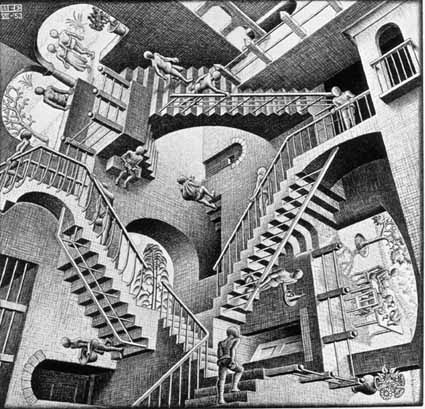
The famous illustration above is M.C. Escher’s “Relativity,” which nicely captures the “what is” / “what is not” capability of the human imagination where even an “absence” is still a “presence” because it can be expressed.  The concept of “relativity” is as distinct from “relativism” as the “imaginative” is from the “imaginary.” “Relativism” seems to dominate current literary criticism which somehow finds its criteria (in ideological constructions such as gender, class, race, and so on) outside of literature as though literature were primarily centrifugal in reference. “Relativity,” on the other hand, requires a constant: in Einstein’s case, that constant accounts for bodies in motion relative to one another.  And, it seems, the same is true for Frye as well; the constant in this case being those primary human concerns which are everywhere evident in literature and provide the impetus for us to communicate at all. Concern is the gestalt of verbal expression; and literature — in its simultaneous acknowledgement of what is and is not as an integral part of its saying — confronts the inadequacies of the world we inhabit with a world we are trying to create through the imaginative expression of our universally shared but individually possessed concerns.
Today in the Frye Diaries, 13 September

Carriere_Belleuse_Pierre_The_Ballerina

1942: Frye has a dream about living in war-ravaged Stalingrad; reflects on “racial stereotype thinking” and the “Gestapo” of Moncton, New Brunswick.

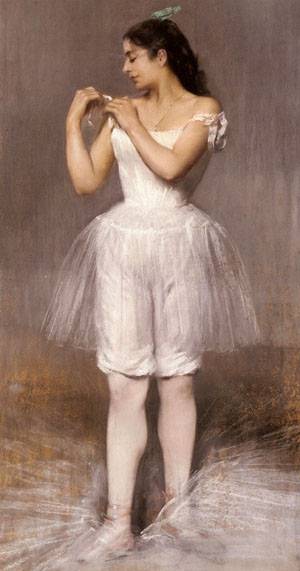
[110] … Last night I dreamed I was living in Stalingrad with a Russian family: the wife a beautiful slim girl copied from some picture of a ballerina. They asked me how I got there & I said quite simple, B.C.-Pacific-Siberia, the Russian transportation system is wonderful east of Stalingrad – you’d hardly know there was a war on. An old woman came & knocked on the door: she was an evil malicious gossip, inquisitive & interfering, & well known to be a German spy. The girl said, “No, you can’t come in: go away, you old tart.” Yet we all had the feeling that sooner or later she would come in, & would order us around as she liked. The I suddenly heard cannonading, which I’d been only vaguely conscious of before, & I knew the Russians had retreated another ten miles. Gradually the old hag forced her way into the vestibule, soldiers (German) starting pouring in, & I woke up.

[111] I often wonder about intuitive racial-stereotype thinking: a lot of it is balls. For instance, there’s a big good-natured German in Moncton called Lichtenberg who had been a peaceful, thrifty, industrious contractor there for thirty years. For two wars the local Gestapo have cut their teeth on him: when the new is bad or they get tired of reading spy stories they’d go up and practice on him. Recently the Gestapo combed his whole house over, in response to some silly anonymous “tip,” & one of them found two large knobs in a dark closet. “Aha!” he said, stepped into the closet & gave one a twist, thinking of course it was a private transmitter set. It was an extra shower he’d installed. Incidentally, he’s a naturalized Canadian citizen, but married before that, so his wife, who belongs to one of the oldest Maritime families, is an enemy alien. Well, Dad’s friendship for Lichtenberg has come in for much unfavorable comment in that stinking little kraal Moncton, & the stinkers point out gleefully that “Frye” is really a German name, & that I look just like a German. It’s a beautiful theory, only it just happens to be wrong.

Adamson and Chrusch: “Both/And”

 paradoxImages2

This exchange in the Comments between Clayton Chrusch and Joe Adamson regarding Joe’s Jacob and the Angel post deserves highlighting.

Clayton Chrusch Says:
September 11th, 2009 at 5:40 pm e

I’ve been following along the podcast of Calvin’s Institutes made available by Princeton Theological Seminary, and though Calvin has little to do with Frye, I’m struck by his use of both/and formulations. Especially in his idea that in any human action, there is a double cause – human will and God’s will.

It’s hard not to see this kind of formulation as sinister and intellectually illegitimate when it’s being used to to justify the ways of a rather sinister god who decides before any sin and before the foundation of the world who would be saved and who would be damned.

Frye was certainly consistent in his both/and approach. Fearful Symmetry describes a kind of human freedom that is both free and a working out of an innate pattern (not that different from Calvin, come to think of it). Are these paradoxes illegitimate, or are they just “fudge factors” awaiting further conceptual clarification, or are they actually the most precise way of articulating some realities?

Joe Adamson Says:
September 12th, 2009 at 10:44 am e

Ouch, Calvin? Well, the paradox in Frye seems very different from Calvin’s. Frye describes it paradoxically and in different ways because perhaps there is no other way of talking about it, so I don’t see how a book on logic is going to help you out here. Frye is talking about the relationship between human creativity and an otherness of consciousness or spirit, Reality, Nature, something uncreated, something coming from elsewhere, the Logos, the Word, or the “order of words” that is our literary and cultural heritage . . . It is perhaps a paradox like Eliot’s originality/individual talent vs. tradition. How else do you describe the relationship between the individual and the greater Reality he keeps running up against, whatever that reality is? “The Word and Spirit chapter” in Words with Power addresses the issue, where it is described in more interpenetrative terms: since the word and spirit go in both directions: the spirit that descends in Acts, when the Word ascends, allows for a human spiritual response to the Word, and there is the necessity of a similar spiritual response to a secular scripture, that is, literature, a human initiative, man’s revelation to man.

Oscar Wilde Says, June 20th, 1890:

The way of paradoxes is the way of truth. To test Reality we must see it on the tight-rope. When the Verities become acrobats we can judge them.

Today in the Frye Diaries, 12 September

i_was_a_male_war_bride

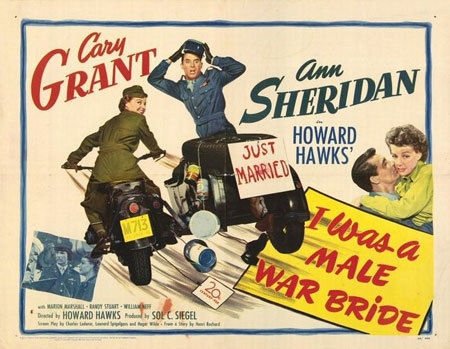
1942: A quite long entry, reflecting on various aspects of civilian life during wartime, including “fascist” tendencies within apparently healthy democracies.

[105] Down to collect Helen & we went to downtown Diana’s [coffee shop, 187 Yonge Street]: absolutely jammed with females. I never knew there were so many women in the world, or so few men. I felt a little like a stud: if I’d been in uniform I’d have felt completely so. There’s a curious sensation about being surrounded by so much female flesh that is hard to analyze. Also on the street, but not quite so bad there. If the war lasts long enough they may start drafting civilian males for stud duty: they’re very near it in Germany now and we generally do what Germany does a year or so later. I’d be category E for the Army, but I’m afraid 1-A for studding. The sendentary are the most sex-ridden of all men, despite a popular superstition to the contrary largely invented by them… A cheap & lousy bookstore has opened on Yonge & Charles. I went all through it to the back, where they had a shelf of semi-erotic books on what they refer to as “sex harmony” and emerged with a Hanford Milton handbook for 15 cents. It’s about time to read it.

[107] I wonder how far-reaching the stopping of travel & touring will be: an enoromous amount of our economy was tied up with it: in the Maritimes, for instance, the roads were a solid line of piss-and-postcard places between villages, where they thickened. Unsound economy, certainly, but wiping it out is a revolution of no small proportions. The effect will be healthiest in Quebec, I think, which was freezing into a Maria Chapdelaine pose of ye olde picturesque rutting & rooting queynte paysan, with of course the Fascist Catholic twist — the Vichious circle of church, pub, field & kitchen.

[108] … Friends of democracy are seldom frank about its failings & I don’t know if anyone has researched the persistence in it of the Aristedes complex. The great heart of the people can put up with conscientious, honest, and efficient government just so long and then they arise in their wrath and demand some form of picturesque graft or colorful tyranny. Recently the Socialist mayor of Milwaukee, who had served his city faithfully for years, was defeated by an obviously incompetent crooner. Now that “Glass Key” picture showed that it’s gangsters, not saints, who attract fanatical loyalty and are impossible finally to crush. Cf. the frank support of child labor in “The Great McGinty“: another film along much the same lines. As compared with the intellectualilzed & comparatively superficial analysis of a Fascist type of Citizen Kane, I think that’s the most important thing for the films to do.