Author Archives: Michael Happy

TGIF: SCTV

httpv://www.youtube.com/watch?v=bB6KFa7-6B4&feature=related

SCTV remains one of the watersheds of television comedy almost 30 years after they called it quits.  They were particularly good at satirizing game shows — sort of paleo-reality television.  Above, “Half Wits”.  After the jump, “Night School High-Q”.

Continue reading

Troy

httpv://www.youtube.com/watch?v=eLs3-zUJc9M

Shakespeare’s Troilus and Cressida, act 2, scenes i and ii

Today is the traditional anniversary of the sack of Troy in 1184 BCE.

Frye on Troy, British national mythology, and Shakespeare in A Natural Perspective:

History is a prominent genre in Shakespeare until Henry V, when it seems to disappear and revive only in the much suspected Henry VIII at the end of the canon.  Yet the history of Britain to Shakespeare’s audience began with the Trojan War, the setting of Troilus and Cressida, and included the story of Lear as well as the story of Macbeth.  Even Hamlet is dimly linked with the period of Danish ascendancy over England.  Alternating with these plays in a Britain older than King John are the Roman or Plutarchan plays, dealing with what, again, to Shakespeare’s audience was the history of a cousin nation, another descendant of Troy.  In Cymbeline the theme of reconciliation between the two Trojan nations is central, as though it were intended to conclude the double series started by Troilus and Cressida.  (66)

John Diefenbaker

diefenbaker

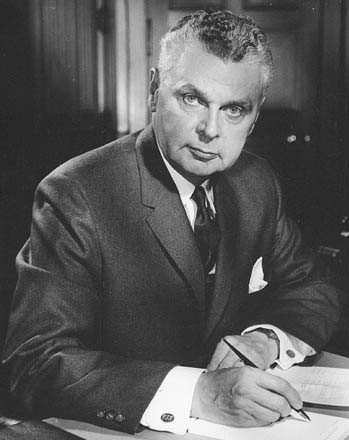
On this date in 1957 John Diefenbaker led the Progressive Conservatives to an upset electoral victory, ending 22 years of Liberal rule.

From Frye’s address on the occasion of Victoria University’s awarding an honorary doctorate to Prime Minister Diefenbaker in September 1961.

It is a sign of an immature society when politicians are contemptuous of eggheads.  It is equally a sign of an immature society when the university is contemptuous of politics, when it congratulates itself unduly on its clean hands and its pure heart.  There is a natural tension between university and government.  Government is based on majority rule; the universities are one of the most effective instruments of minority right.  The university seeks truth at all cost; the government must seek compromise at all cost.  The university, like a totalitarian state, is exclusive, and holds annual purges to remove those who do not support it with sufficient energy.  The government, in a democracy, must deal with all the people, and Mr. Diefenbaker was no less representing the people of Canada when he was Leader of the Opposition than he does now.  The university tries to abolish conflicting opinion by facts and evidence; the government must reconcile conflicting opinion in an area where all facts and evidence come too late.  What the university stands for demands admiration and respect from government; what the government stands for demands admiration and sympathy from the university.  It is this equal pact that is symbolized by the honour which the Prime Minister has done us in accepting our degree, and by our desire to honour him in offering it.  (CW 12, 314-15)

Kim and Kelley Deal

httpv://www.youtube.com/watch?v=Hvi4iA3PnKE

Kim Deal and the Pixies, “Here Comes Your Man”

Today is the birthday of the Deal sisters, Kim and Kelley (born 1961).  Yes, yes, this is strictly a personal indulgence.  But if relevance is required, here’s Frye in a 1978 interview responding to a question about the relationship between scholarship and popular culture.

I think that what interest I have in popular culture has largely grown out of my teaching interest.  That is, I have always said that if you’re faced with a reluctant ten-year-old in a classroom and you’re trying to teach him literature and he prefers something he saw on TV the night before, the way to approach him is not to say, “Well this is good for you and that’s bad for you,” but to say, “Look, there are certain resemblances in structure between what I’m trying to give you and what you just saw.”  I think that pedagogically that’s reasonably sound.  That’s really where my interest in popular culture comes from–the fact that it records the same conventions and genres as serious literature, which of course keeps continually growing out of popular roots, just as Shakespeare grew out of the popular theatre.  (CW 24, 422-3)

Quote of the Day: “War Criminal”

bush_finger_web_2

“The phrase ‘war criminal’ is loaded with negative connotations and often used pejoratively in political discourse, but that doesn’t change the fact that whether or not someone has committed war crimes is a legal question, not a moral one. A patriot is someone who loves their country. It is perfectly possible to be a patriot, to perform patriotic acts in a war, and to commit a war crime in the course of doing so.”

Conor Friedersdorf

Joseph Welch vs Joseph McCarthy

httpv://www.youtube.com/watch?v=MO2iiovYq70

On this date in 1954, Joseph Welch, counsel for the United States Army, brought the McCarthyite juggernaut to a juddering halt with a courageous and heartfelt confrontation of the fatally alcoholic junior senator from Wisconsin.

This is how the democratic body politic is supposed to cleanse itself of demagoguery: with the fearless application of free speech.  Note the spontaneous round of applause from the audience at the end of the above clip.

There was at least one well-known Canadian victim of McCarthyism, Frye’s former classmate and distinguished diplomat and scholar Herbert Norman, whom Frye refers to in an interview (CW 24, 643) as hounded into suicide.  (CBC Radio news report on Norman’s death here.)

Plus ça change: From Frye’s diary entry for February 12, 1952:

We talked American politics with Ken [MacLean].  Nothing especially new — he says if Taft gets the Republican nomination the election will be practically civil war, as Taft could only win with the kind of all-out support he’d get from McCarthy.  (CW 8, 507)

Now imagine a Palin candidacy in ’12 and the Great Rightwing Noise Machine shrieking lies and barely-veiled threats 24/7 for an entire election season.

After the jump, a contemporary demagogue, Ann Coulter, at the grave of her self-declared hero (this last link is to a terrific clip in which now Senator Al Franken takes on Coulter and shows her what being provocatively funny really means).

Continue reading

Richard le Scrope & Thomas Mowbray

OnShakespeare

On this date in 1405, Richard le Scrope, Archbishop of York, and Thomas Mowbray, Earl of Norfolk, were executed for treason by order of Henry IV.

Shakespeare renders the arrest of le Scrope, or Scroop, and Mowbray at the end of act IV, scene ii of 2 Henry IV:

Lord Hastings. My lord, our army is dispers’d already.
Like youthful steers unyok’d, they take their courses
East, west, north, south; or like a school broke up,
Each hurries toward his home and sporting-place.
Earl of Westmoreland. Good tidings, my Lord Hastings; for the which
I do arrest thee, traitor, of high treason;
And you, Lord Archbishop, and you, Lord Mowbray,
Of capital treason I attach you both.
Lord Mowbray. Is this proceeding just and honourable?
Earl of Westmoreland. Is your assembly so?
Archbishop Scroop. Will you thus break your faith?
Prince John. I pawn’d thee none:
I promis’d you redress of these same grievances
Whereof you did complain; which, by mine honour,
I will perform with a most Christian care.
But for you, rebels—look to taste the due
Meet for rebellion and such acts as yours.
Most shallowly did you these arms commence,
Fondly brought here, and foolishly sent hence.
Strike up our drums, pursue the scatt’red stray.
God, and not we, hath safely fought to-day.
Some guard these traitors to the block of death,
Treason’s true bed and yielder-up of breath.

That’s about as nausea-inducing an instance of victor’s justice as can be found.  Frye in On Shakespeare:

In this play Henry IV is near his death: he is perpetually exhausted and he can’t sleep.  His great strength has always been in his ability to take short views, to do what has to be done at the time and not worry about the remoter perspectives.  But in this play a long and desolate speech breaks out of him about how any youth, if he could see the entire pattern of time stretching out in front of him, would simply lie down and die and refuse to go through with it.  The nemesis of usurpation is working itself out: a good deal of the discussion between the king’s party and the rebels consists of rehashing feuds and grudges that go back to the beginning of Richard II, or even earlier.  The implication is partly that rebellion is, among other things, caused by a sterile brooding on history with the object, not of building up a future, but of reshaping the past.  (80)