Author Archives: Michael Happy

Frye Alert

PSFK Management (l-r): Jeff Weiner (Business Development), Dan Gould (Content), Hedyeh Parsia (Events & Operations), Piers Fawkes (Founder & CEO), Scott Lachut (Consultancy)
PSFK Management, left to right: Jeff Weiner (Business Development),
Dan Gould (Content), Hedyeh Parsia (Events & Operations), Piers Fawkes
(Founder & CEO), Scott Lachut (Consultancy)

PSFK is a New York City based trends research and innovation company that publishes a daily news site, provides trends research and innovation consultancy, manages a network of freelance experts and hosts idea-generating events. We aim to inspire our readers, our clients and our guests to make things better – whether that’s better products, better services, better lives or a better world.

— From the PSFK Website

I’m not sure exactly what most of that entails, but I do know that PSFK put up a long post yesterday — “Four Storytelling Genres of Brand Re-Invention” — adapting Frye’s theory of myths wholesale (although they probably should have valued it retail).  A sample:

The literary critic Herman Northrop Frye explored the typology of narrative genres. He emerged with a core set, you might call the Four Seasons; Romance, Tragedy, Comedy, and Irony. These archetypal genres play an important role in the history of literary traditions, media, and the cultural psyche. Frye argued that most stories about the human experience fall into one of these four general buckets. There’s some great insight to draw on when it comes to the process of re-invention.

1. ROMANCE represents a “back to origin” story thru re-commitment to core values and re-interpretation of the past.

This is a very popular genre that guides many if not most brand re-inventions. The Obama political campaign was based on these principles. While the message was built on change, it was always in the context of fulfilling our ancient promise and manifest destiny as a nation. Those famous Moleskine notebooks is equally a story of an almost defunct brand with legendary origins, brought back from obscurity and re-packaged for the new context of culture creatives.

Another great example is that of Apple. Just last week Apple replaced Microsoft as the largest market cap tech company in the world. Yet back in 1997, Apple was in a different place. When Steve Jobs returned, it was on the brink of bankruptcy, and a strong acquisition target. Jobs re-ignited the fire – by reminding people of the company’s DNA and its legacy for free-spirited ingenuity. Its no small coincidence, that equally in 1997 Apple launched its groundbreaking Think Different campaign. It announced first to itself and then the world, that it remembered who it really was.

2. TRAGEDY is the classic redemption storyline.

We love it when our heroes fall from grace only to get back up for another chapter. It’s how Donald Trump and Martha Stewart got a second chance and each became ever bigger global brands. And it’s what both Toyota and Tiger Woods are now desperately praying they can accomplish.

Domino’s Pizza is an example of a big brand success to give us hope. The brand hit rock bottom last year after two employees posted a Youtube video with distasteful food pranks played on unsuspecting customers. The scandal that ensued but Domino’s in the brand reputation hot seat.

Fast forward to the spring 2010. Domino’s current campaign is a mea culpa to the world. In the ads, executives acknowledge how they lost touch with the quality and taste of their product. In turn, they listened soberly to customer complaints and have re-formulated their pizza into something they can be proud of. They’ve also created a marketing campaign with incentives for people to come back and give them a chance. Two medium pizzas for just $5.99 each! I’m getting hungry just thinking about it.

Continue reading

Stan Rogers

httpv://www.youtube.com/watch?v=ZIwzRkjn86w&feature=PlayList&p=900A3A78F77E8E9B&playnext_from=PL&playnext=1&index=9

“Barrett’s Privateers”

On this date Canadian folk singer Stan Rogers died in a fire on an Air Canada flight (1948 – 1983).  Stan lived in my hometown of Dundas, Ontario, but he really belonged to the Maritimes.  I was once in a Prince Edward Island pub where a crowd of about 50 people broke into “Barrett’s Privateers“, stamping their feet to keep the time, and sang every damn verse.

“Now I’m a broken man on a Halifax pier / The last of Barrett’s Privateers”

“Les Fleurs du Mal”

httpv://www.youtube.com/watch?v=s-Q87doHJlA&feature=related

“Hymne à la beauté”

On this date in 1857 Charles Baudelaire’s Les Fleurs du Mal was first published.

In this excerpt from “The Literary Meaning of ‘Archetype'”, Baudelaire only gets a passing mention, but his work is nevertheless associated with a constellation of archetypes.

This aspect of symbolism is what I mean by archetypal symbolism.  I should tentatively define an archetype, then, as a symbol, that is, a unit of a work of literary art, which connects one poem with another and thereby helps to unify and integrate our literary experience.  The archetype is thus primarily  the communicable symbol, and archetypal criticism is particularly concerned with literature as a social fact and as a technique of communication.  By the study of conventions and genres, it attempts to fit poems into a body of poetry as a whole.  It is the only method of criticism known to me in which it is really necessary to assume that there is such a subject as comparative literature.

Or even, we may say, that there is such a subject of literature at all.  The repetition of certain common images of physical nature like the sea or the forest in a large number of poems cannot in itself be called even “coincidence”, which is the name we give to a piece of design when we cannot find a use for it.  But it does indicate a certain unity in the nature that poetry imitates.  And when pastoral images are deliberately employed in Lycidas, for instance, merely because they are conventional, we can see that the convention makes us assimilate these images to other parts of literature.  We think first of its descent from the ritual of the Adonis lament down through Theocritus, Virgil, and the whole pastoral tradition to The Shepheardes Calendar, then of the intricate pastoral symbolism of the Bible and the Christian Church, then of the extensions of pastoral symbolism into Sidney’s Arcadia, The Faerie Queene, Shakespeare’s forest comedies, and so on, then of the post-Miltonic development of pastoral elegy in Shelley, Arnold and Whitman.  We can get a whole liberal education simply by picking up one conventional poem and following its archetypes as they stretch out into the rest of literature.  Expanding images into conventional archetypes is a process that takes place unconsciously in all our reading.  A symbol like the sea or the paradisal garden cannot remain within Conrad or Green Mansions; it is bound to expand over many works into an archetypal symbol of literature as a whole.  The ancient mariner’s albatross links us to Baudelaire and his ship to Rimbaud’s bateau ivre; Yeats’s tower and winding stair blend into Dante’s Purgatory, like their more explicitly allusive counterparts in Eliot; and Moby Dick merges into the leviathan of Job.  There is only one hypothesis that will prevent this linking of archetypes in our reading from being simply free association.  That is the hypothesis that literature is a total form, and not simply the name given to the aggregate of existing literary works.  In other words, we have to think, not only of a single poem imitating nature, but of an order of nature as whole being imitated by a corresponding order of words.  (CW 10, 184-5)

Walt Whitman

httpv://www.youtube.com/watch?v=yBX2L_Re5Cc

A wax recording of Whitman in 1890

Today is Walt Whitman‘s birthday (1819 – 1892).

Frye in The Modern Century:

When the Romantic movement began, there was one important primitive influence on it, that of the oral ballads, which began to be collected and classified at that time.  The oral ballad makes a functional use of refrains and other strongly marked patterns of repetition, which correspond to the emphasis on design in the primitive pictorial arts.  The fact that it depended for survival on an oral tradition meant that whatever personal turns of phrase there may originally have been in it were smoothed out, the poem thus acquiring a kind of stripped poetic surface quite unlike that of written poetry.  The literary ballads which imitate these characteristics — the Lyrical Ballads of Wordsworth and Coleridge, Blake’s Mental Traveller, Keats’s La Belle Dame Sans Merci — come about as close as poetry can come to reproducing directly the voice of the creative powers of the mind below consciousness, a voice which is uninhibited and yet curiously impersonal as well.  This was also the “democratic” voice that Whitman attempted to reproduce, and Whitman is the godfather of all the folk singing and other oral developments of our time which cover so large an area of contemporary popular culture.  (CW 11, 54)

Christopher Marlowe

httpv://www.youtube.com/watch?v=foOquPn1L60

Rupert Everett as Marlowe in Shakespeare in Love

On this date Christopher Marlowe was murdered (1564 – 1593).

Frye on the relation of Marlowe, Shakespeare and Webster in Notebook 9:

In my young days I said that Marlowe’s characters were demigods moving in a social ether, that Webster’s were “cases” of a sick society, & that Shakespeare was the transition from one to the other.  Well, it’s true that in DM [The Duchess of Malfi], for example, there is no order-figure because there is no genuine society: there is a Dionysiac health-figure instead, the Duchess herself, & society itself, personated by Ferdinand & the Cardinal, is the action-figure.  I think that this is the kind of tragedy adumbrated by Chapman in B d’A [Bussy D’Ambois].  Yet even Tamburlaine is a scourge of God, the destructive nature let loose in a society that has no God.  I suppose Shakespeare’s nearest approach to a social tragedy of the Webster kind is really Coriolanus rather than TC [Troilus and Cressida]: Co has no de jure magic because he can’t crystallize any kind of society, as Antony can. (CW 20, 254-5)

Frye on the Group of Seven

ayjacksonredmaple

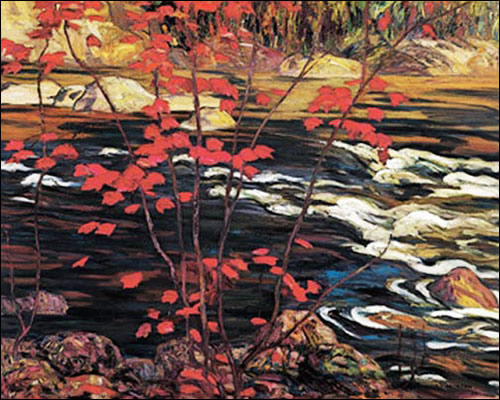
A. Y. Jackson, “Red Maple”

Jeff Mahoney of the Hamilton Spectator has an article today about a Westdale couple who’ve hunted down scores of locations featured in the paintings of the Group of Seven.  This provides a nice opportunity to cite Frye on that remarkable group of painters.

From “Canadian Scene: Explorers and Observers”:

“[T]he primary rhythm of English Canadian painting has been a forward-thrusting rhythm, a drive which has its origin in Europe, and is therefore conservative and romantic in feeling, strongly attached to the British connection but ‘federal’ in it attitude to Canada, much possessed by the national motto, a mari usque ad mare.  It starts with the documentary painters who, like Paul Kane, have provided such lively and varied glimpses of so many vanished aspects of the country, especially of Indian life.  A second wave began with Tom Thomson, continued through the Group of Seven, and has a British Columbia counterpart in Emily Carr.  (The romantic side of the movement is reflected in the name ‘Group of Seven’ itself: there were never really more than six, in fact there effectively only five, but seven is a sacred number, and the group had a strong theosophical bent.)  One notices in these painting how the perspective is so frequently a twisting and scanning perspective, a canoeman’s eye peering around the corner to see what comes next.  Thomson in particular uses the conventions of art nouveau to throw up in front of the canvas a fringe of foreground which is rather blurred, because the eye is meant to look past it.  It is a perspective which reminds us how much Canada developed as a passage or gateway to somewhere else, being merely an obstruction in itself.  Further, a new world is being discovered.  There is an immense difference in felling between north and south Canada, but as north Canada is practically uninhabited, it exists in Canadian painting only through southern eyes.  In those eyes it is a “solemn land” as frightening and fantastic as the moon.  (CW 12, 422-3)

From “Lawren Harris”:

As a rule, when associations are formed by youthful artists, they break up as the styles of the artists composing them become more individual.  But the Group of Seven, who did so much to revitalize Canadian painting in the ’20s and later of this century, still retain some of the characteristics of a group.  Seven is a sacred number, and the identity of the seventh, like the light of the seventh star of the Pleiades, has fluctuated somewhat, attached to different painters at different times.  But the permanent six, of whom four are still with us, have many qualities in common, both as painters and in fields outside painting.  For one thing, they are, for painters, unusually articulate in words.  J.E.H. MacDonald and Lawren Harris wrote poetry; Harris, as his book shows, wrote also a great deal of critical prose; A.Y. Jackson produced a most entertaining autobiography; Arthur Lismer, through his work as educator and lecturer, would still be one of the greatest names in the history of Canadian art even if he had never painted a canvas.  For another, they shared certain intellectual interests.  They felt themselves part of the movement towards the direct imaginative confrontation with the North American landscape which, for them, began in literature with Thoreau and Whitman.  Out of this developed an interest for which the word theosophical would not be too misleading if understood, not in any sectarian sense, but as meaning a commitment to painting as a way of life, or, perhaps better, as a sacramental activity expressing a faith, and so analogous to the practicing of a religion.  This is a Romantic view, following the tradition that begins in English poetry with Wordsworth.  While the Group of Seven were most active, Romanticism was going out of fashion elsewhere.  But the nineteen-sixties is once again a Romantic period, in fact almost oppressively so, so it seems a good time to see such an achievement as that of Lawren Harris in better perspective.  (CW 12, 398-9)

“The Rite of Spring”

httpv://www.youtube.com/watch?v=Z0xNo2894Fw

On this date in 1913 Stravinsky’s The Rite of Spring premiered in Paris.

Frye in an April 1936 review of the Jooss Ballet in The Canadian Forum:

So the ballet has gone through a period of transition.  It has used incidental music not originally intended for it, and the greatest of the composers treating it seriously as an art form — Stravinsky — has been temperamentally unsuited to it, for though he clearly recognizes, and has explicitly stated, the necessity of impersonality and convention, his own style tends toward the vehement spluttering of Wagner and Tschaikowsky rather than the more objective balance required.  Behind Stravinsky there is the “emigre” Russian ballet, associated with the names Diaghilev, Massine, and Nijinsky.  A typical product of this school visited Toronto last fall, and the laboured virtuosity of its dancing, the eternal jiggling monotony of its nineteenth-century music, its set poses, rococo pictorial backgrounds, and vaguely allegorical programs amply showed how far the ballet had yet to go.  (CW 11, 80 – 1)