httpv://www.youtube.com/watch?v=jaWsewOKhgw
Further to Joe’s post, Todd Alcott’s “Television is a Drug”.
httpv://www.youtube.com/watch?v=jaWsewOKhgw
Further to Joe’s post, Todd Alcott’s “Television is a Drug”.
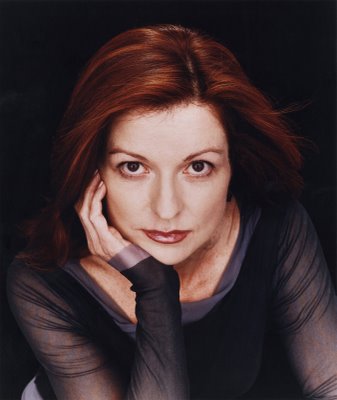
“Obambi”. That’s Maureen Dowd‘s nickname for Obama which she employed right through the primaries until his nomination in 2008. The problem with it? Well, it of course has nothing to do with anyone recognizable as Barack Obama, a remarkably capable politician who, by the time he’d announced his candidacy, had already made a career of overseeing the self-destruction of his opponents. But Dowd pushed the “Obambi” conceit for almost two years because she could. As is regularly the case, she lacked the discipline to weigh whether or not she should. This, remember, is the same person who during the 2000 election gleefully perpetuated the fiction that Al Gore claimed to have “invented the internet”, and suggested that he is “so feminized” that he is “practically lactating”.
And that’s a pattern of behavior with Dowd which is disturbing for at least a couple of reasons. The first is that she never lets a fact get in the way of a low blow she regards as clever, and the second is that she has an unmistakable tendency to feminize males in order to dismiss them — and moreover does so almost exclusively with Democrats, calling them “the mommy party” (you can guess who “the daddy party” is). She likewise occasionally masculinizes women for much the same purpose, most especially Hillary Clinton — or “Hillzilla”, as Dowd dubbed her during the primaries. Gender stereotyping is one of a number of strategies that Dowd regularly resorts to in place of anything that might be characterized as responsible criticism.
Here are some notable examples of Dowd’s effort to emasculate Obama — because girly-men are, you know, self-evidently a joke that everybody gets: “diffident debutante“, “America’s pretty boy“, “effete“, “emotionally delicate“, “weak sister“, “legally blonde“. Ask yourself: Does any of this even remotely coincide with your estimation of the man, however you feel about his politics? And why diminish him with feminine comparisons? What is going on here?
This is just one thread in a whole skein of such behavior. Media Matters for America has a more complete catalogue of Dowd’s persistent use of gender stereotypes here. Allegedly feminized men are not fit to govern according to Dowd, and most certainly not when they are Democrats. But “tough guys” like John McCain (who once publicly called his wife a cunt) can, when the mood is upon her, set Dowd’s atavistic heart aflutter. It is so persistent a pattern that it’s difficult not to wonder what lies behind it.
This matters because the Times is the flagship of a supposedly “liberal media”, and its opinion makers still draw a lot of water. Dowd in particular plays the celebrity circuit with personal profiles in mass circulation magazines and appearances on television whenever she has a book to sell, such as the widely panned Are Men Necessary? We live in a world where we’re apparently required to put up with the lies that Fox News manufactures on an hourly basis in the name of “balance”. So it’d be nice if the paper of record didn’t propagate twice a week the neurotic, unfunny, unclever babble of Maureen Dowd, which gets said not because it necessarily has anything to do with anything that is actually happening, but because it is formulated by someone who isn’t responsible enough not to say it.
httpv://www.youtube.com/watch?v=Nt7pPKXDhPc
The anniversary of the first performance of Beethoven’s Ninth Symphony passed earlier this week, so here is the entire thing, conducted by Arturo Toscanini.
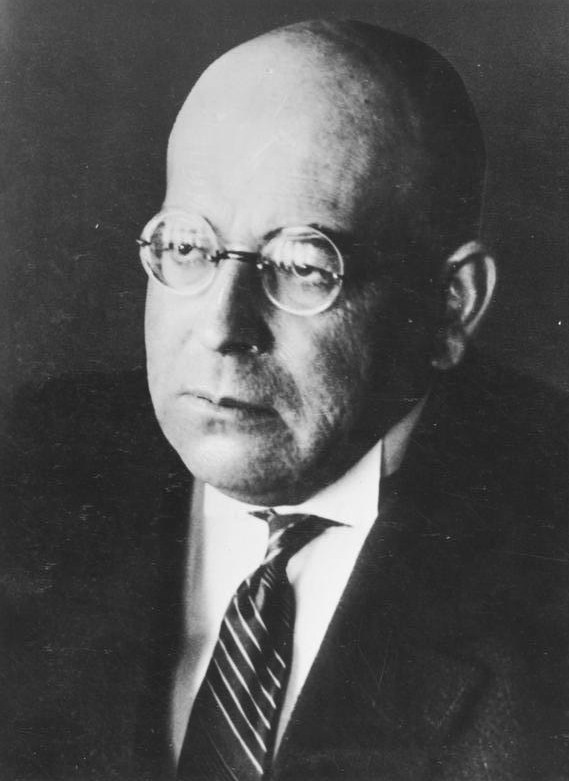
On this date Oswald Spengler died (1880 – 1936).
Frye’s “Spengler Revisted” can be found here.
Frye in one of the late notebooks:
Spengler: I never did buy his “decline” thesis, which I realized from the beginning was Teutonic horseshit, closely related to the Nazi hatred for all forms of human culture. (Well, not just Nazi; Stalin had just as much of it.) No, as I’ve said, what struck me was, first, the sense of the interpenetration of historical phenomena, a conception of history in which every phenomenon symbolizes every other phenomenon.
Along with that came the conception of a culture in which works of culture show a progressively aging process. You have pure tradition in primitive societies, where conventions just repeat over and over, and you have a culture in which tradition accruse a self-consciousness in regard to itself, so that it must be where it is: i.e. Beethoven could only have come between Mozart and Wagner. This growth of self-awareness in tradition is recapitulated in the life of the poet or artist, which gives biography a genuine function in criticism. (CW, 6, 649)
httpv://www.youtube.com/watch?v=vlmGknvr_Pg
It’s a hung parliament in Britain, and it’s not yet clear what will happen next. Here’s the classic Monty Python North Minehead By-Election sketch, featuring Mr. Hilter, Mr. Bimmler, and Ron Vibbentrop.
httpv://www.youtube.com/watch?v=B_5z0m7cs0A
“Ode to Joy” finale conducted by Leonard Bernstein
On this date in 1824 Beethoven’s Ninth Symphony premiered in Vienna.
Frye in a letter to Helen Kemp, April 18th, 1934:
I heard the ninth symphony last night. There was some Wagner ahead of it that didn’t amount to much. I enjoyed the symphony, though that Ode to Joy bothered me as usual. I would like to hear the 9th as the only thing on the programme, with the Ode sung in some language I don’t understand. The translation was execrable. The singing was all right, or would have been if it had been possible to sing that infernal orgy at all — most of it is simply sopranos screaming on an A flat, a sound which fairly pulls my own vocal chords apart in pure sympathy. The symphony itself is prolix — suprisingly so, I think, but the general effect is tremendously exhilarating and disturbing. Exhilarating because of the size of the attempt, disturbing because the attempt is strained and in the last analysis unsuccessful. The symphony, big as it is, is only a torso of a complete subjective component of musical form. (CW 1, 201)
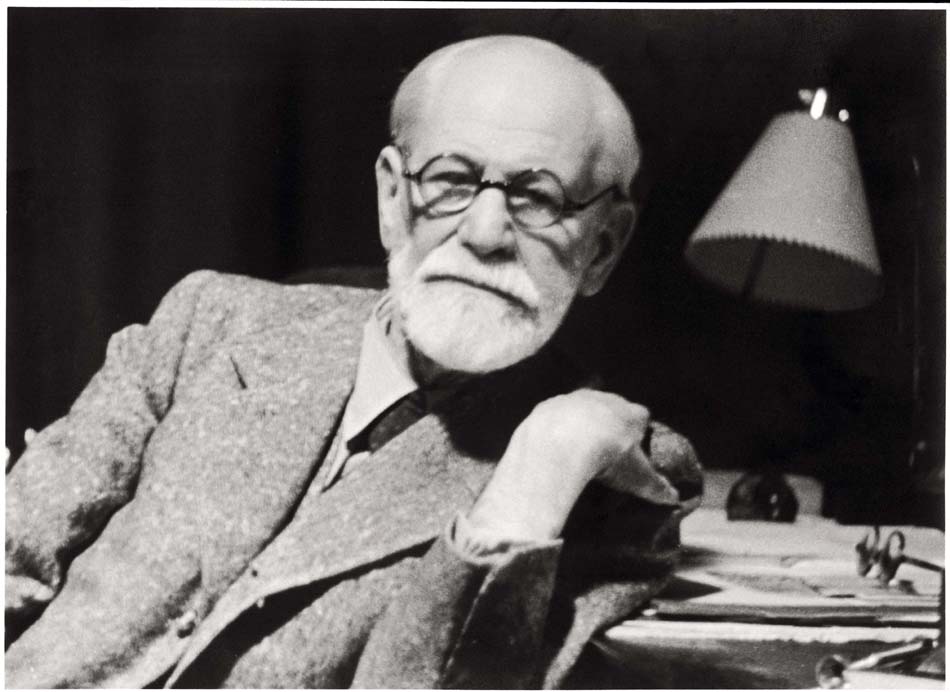
Today is Freud‘s birthday (1856 – 1939).
Frye on psychological analogues of romance in The Secular Scripture:
When we look at social acts as rituals, we become at once aware of their close relation to a good deal of what goes on within the mind. Anyone reading, say, William James’ Varieties of Religious Experience must be impressed by the extraordinary skill with which many people arrange their lives in the form of romantic or dramatic ritual, in a way which is neither wholly conscious nor wholly unconscious, but a working alliance of the two. William James takes us into psychology, and with Freud and Jung we move into an area where the analogy to quest romance is even more obvious. In a later development, Eric Berne’s “transactional” therapy, we are told that we take over “scripts” from our parents which it is our normal tendency to act out as prescribed and invariable rituals, and that all possible forms of such scripts can be found in any good collection of folktales. Romance often deliberately descends into a world obviously related to the human unconscious, and we are not surprised to find that some romances, George MacDonald’s Phantastes, for example, are psychological quests carried out in inner space. Such inner space is just as much of a “reality,” in Wallace Stevens’ use of the word, as the Vanity Fair of Thackeray: Vanity Fair itself, after all, is simply a social product of the illusions thrown up by the conflicts within his inner consciousness. When we look back at the Cistercian developments of Arthurian legend, with their stories of Galalhad the pure and his quest for the Holy Grail, we see that an identity between individual and social quests has always been latent in romance. (58)
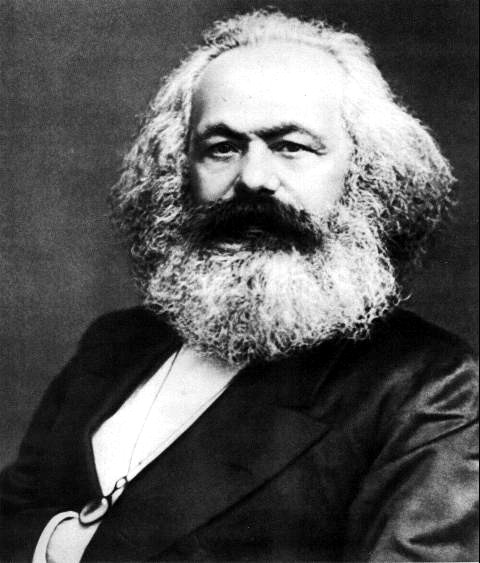
Today is Karl Marx‘s birthday (1818-1883).
Frye in one of the “Third Book” notebooks:
Marx himself was undoubtedly a great writer in the anatomic tradition: he had the satirist’s truculence, excremental imagery, & inability to finish books. (This aspect of ironic mythos is the counterpart of the endless form of romance.) If Norman Brown’s book [Life Against Death: The Psychoanalytic Meaning of History] had been obsessed by Marx instead of Freud, & he had added Marx to his studies of Luther & Swift, he’d have written an even more remarkable book.
The point is that literary criticism has to develop canons for — not judging, but — incorporating Marx, Freud, Luther, Paul, Jesus, instead of allowing determinists to make them a standard for critical categories. (CW 9, 80)
httpv://www.youtube.com/watch?v=E7VxqAtgZF0
Neil Young, “Ohio”
Today is the 40th anniversary of the Kent State shootings.
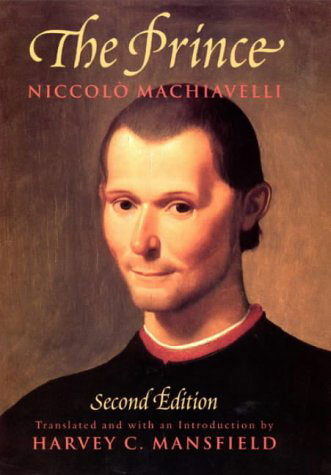
Today is Marchiavelli‘s birthday (1469 – 1527).
Frye in Fools of Time:
In Shakespeare’s day there was no permanently successful example of popular sovereignty. Machiavelli had drawn the conclusion that there are two forms of government: popular governments, which were unstable, and what we should call dictatorships, the stability of which depended upon the cunning and force of the prince. This analysis, of course, horrified the idealists of the sixteenth century who were trying to rationalize the government of the prince with arguments about the “general good”, and so Machiavelli became, by way of attacks on him, a conventional bogey of Elizabethan drama. From the view of tragic structure, what Machiavelli was doing was destroying the integrity of tragedy by obliterating the difference between the order-figure and the rebel-figure. Machiavelli comes to speak in the prologue of The Jew of Malta, and there he asks: “What right had Caesar to the Empire?” — in itself surely a fair enough question, and which expresses the central question in the tragedy of order. (Fools of Time, 20)