Author Archives: Michael Happy

Typology, Kerygma, and Literature

Elohim

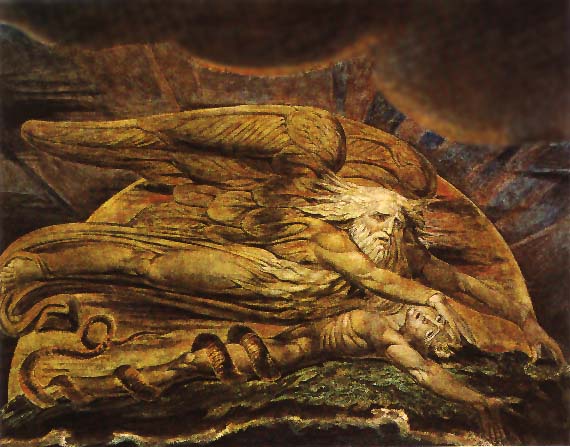
Blake's Elohim Creating Adam

Russell’s latest post on Alter and Frye has got me thinking about my longstanding assumptions about Frye, particularly with regard to the Bible and literature.  The Bible and literature occupy the centre of Frye’s critical universe, and understanding what he says about both is to appreciate the full potential of his critical vision.

The Judeo-Christian Bible as the supreme artifact of Christian culture down to about the 18th century is of course easy enough to assume.  As Frye points out, the Bible is a primary source of imagery and stories well into the 20th century — and, in these apparently apocalyptically-minded times, into the 21st century as well.

But the Bible is not just a source of mythos and dianoia, to use the Aristotelian terms Frye adapts in Anatomy.  It is the source also of a “unique” arrangement of myth and metaphor represented by typology, the progressive succession of type-antitype-type (e.g. Creation-Incarnation-Revelation).  Although Frye rather conspicuously only says it once, he nevertheless observes on page 80 of The Great Code:

The typological organization of the Bible does present the difficulty, to a secular literary critic, of being unique: no other book in the world, to my knowledge, has a structure even remotely like that of the Christian Bible.

That structure is the “double mirror” of the Old Testament and the New Testament — the latter concealed in the former and the former revealed by the latter — which provides the Christian Bible’s kerygmatic vision of the human condition that Blake characterizes as the revelation of  the “human form divine.”  The typological structure of the Christian Bible that furnishes its distinctive double mirror character, however, does not originate with Christianity: the Hebrew Bible is the source of these typological principles, and the first “Christians” were themselves Jews who compiled what would become their “new” testament using the same typological structure of their traditional holy scriptures.  As Frye observes:

Typology in the Bible is by no means confined to the Christian version of the Bible: from the point of view of Judaism at least, the Old Testament is much more genuinely typological without the New Testament than with it. There are, in the first place, events in the Old Testament that are types of later events recorded also within the Old Testament.  (GC, 83)

When Frye suggests, therefore, as he does in The Great Code (and there alone, it might be pointed out) that the culturally ascendant phases of language we have observed so far — the hieroglyphic, the hieratic, and the demotic — may be, for the first time in human history, about to be succeeded by a kerygmatic phase, he is making about as revolutionary a statement as he ever made.  I’m not sure it is possible to approach his work as a whole without thinking about its implications.

Continue reading

Coming Soon: Frye’s Religious Knowledge Lectures

HotNewsIcon

Bob Denham has made a remarkable discovery: a full set of notes of Frye’s undergraduate course on Religious Knowledge.  Bob describes them as follows:

Course notes for twenty‑four lectures (September 1947 to March 1948)  compiled by Margaret Gayfer from her class notes, incorporating some notes by Richard Stingle.  They also include some of Frye’s answers to questions, and his review of the previous week’s lecture.

Margaret Gayfer and Richard Stingle were members of what Frye said was the “most brilliant” class he ever taught (1947–48).  Gayfer became an editor for the International Council for Adult Education.  She is the author of The Multi-grade Classroom––Myth and Reality: A Canadian Study (1991), An Overview of Canadian Education (1991), and numerous other publications on adult education.  Richard Stingle, who did his graduate work at the University of Wisconsin, taught English at the University of Western Ontario.

We don’t have to belabor how exciting a find this is.  We will start posting them over the weekend, one lecture per day over the next three weeks.

“A First-Class Scholar in a Second-Class Institution”

 Northrop_Frye_Hall

Like Russell, I am reading Bob Denham’s selection of Frye’s correspondence.  This observation to Edith Sitwell in April 1948 caught my attention:

Once a critic learns his job, criticism ought to come very easily, for if he is writing about a greater man than himself (the normal procedure), he has that man’s power available  and ready to be tapped, if he will only realize that it is greater, and puncture a hole in the dam of his own ego.  The arrogance and self-sufficiency I find in so much contemporary criticism, especially in America, bewilders me, as it seems to make things needlessly difficult.

The “arrogance and self-sufficiency” of scholars seems to be a perennial problem.

As Russell points out, Frye dedicated himself to Victoria College, even though in the diaries (which end in 1955) he complains about how stifling the institution could be and occasionally wonders if he shouldn’t take up one of the better offers coming his way.  On January 19, 1950, he observes, “I am worried about my future as a first-class scholar in a second-class institution.”

“Recent Comments”

icon_news_32

Someone suggested recently that we have a “Recent Comments” in our Widgets Menu to the right, so that’s what we’ve done.  It’ll help people get an idea of how the discussion thread in various posts is developing.  For example, Robert Wade Kenny has just added a long Comment on Interdisclinary Connections, which was first posted back on September 25th.

Speakeasy

httpv://www.youtube.com/watch?v=5hw4BIYh-2s

Show business kids makin’ movies of themselves / You know they don’t give a fuck about anybody else. Steely Dan, “Show Biz Kids“. (Rickie Lee Jones‘s superior cover of the song is featured above).

When Joe Adamson and I were thinking about setting up this blog, Joe said that he wanted it to be like the best aspects of a conference: people milling around amid the serious business of papers and panels, talking, laughing, enjoying one another’s company, with all of the unexpected pleasures and discoveries that come with it.  It’s a good analogy.

For me the analogy is more like a gin joint.  The occupants — having knocked, identified themselves, and gained ready admission — are smart, know what they’re about, and, their tongues loosened, are free to say whatever they want.  We keep good company but are up for shenanigans, maybe even fisticuffs, if necessary.  But the most important thing is that the talk take any form that follows and follow any path it finds.

And that has certainly been true this last week. Over the last couple of days, for example, the conversation — initiated by Russell Perkin and with significant contributions from Clayton Chrusch, Matthew Griffin, Joe Adamson, and Bob Denham — has  centred on Frye, religion, the Bible, and The Great Code.

One of the best things about administering the blog with Joe is that we must deal with every comment and post that comes our way; and, of course, there’s a rich email correspondence going on behind the scenes.  That combination — posts, comments, email — has really clarified at least a couple of things for me this past week.  The first is that even with our small core of regular contributors, we speak with many voices, and that’s exactly what Joe and I hoped for.  What we all have in common are varying degrees of admiration for Frye, but it’s also very clear how diverse our views can be.  The debate we’re having is the sort of thing I’ve dreamed of for a very long time, and I’m enjoying it now with some of the best company imaginable, whose numbers I expect will only increase.

The other issue that’s been clarified for me is confronting what it means to be the kind of Frygian I am, and that’s been helped especially by the email correspondence.  What I’ve had to deal with in particular are the implications of truly, genuinely believing that there was an historical divergence in literary theory and criticism about forty years ago, represented primarily by Derrida and deconstruction on one side and Frye and recreation on the other, and that the road not taken was the better one. Frye, for me — and I know I’m not alone in this — is more than just another literary critic, a great among greats.  For many of us, he is a rare sort of genius whose presence on the scene changes it. As Joe put it the other day, picking up on a suggestion by Michael Sinding, maybe Frye was the paradigm shift that literary scholarship as a whole just can’t see yet.  Jonathan Allan earlier this week cited McMaster’s David Clark’s remarks on Frye and Derrida:

I want to say right away that Frye’s work is richly significant. He played a crucially important role in the history of Canadian letters and in the life of a particular Canadian academic imaginary, signs of which are still to be found in the university. One of the things we have yet to see, though, are slow readers–to remember something Nietzsche once said–of Frye’s work, i.e. readers who put enough confidence in the complexity and critical power of his work to be willing and able to read it resistantly and against the grain, and to read it symptomatically, with an eye to its productive self-differences, occlusions, and unconsciousnesses.

Well, okay: “a particular Canadian academic imaginary, signs of which are still to be found in the university”?  Maybe. But perhaps scholars like Clark might acknowledge at this point that insisting upon “against the grain” readings is not exactly kicking at the pricks, and the reflexive demand “to read it symptomatically” is possibly only a symptom of a deeper pathology.  Today’s established literary scholars may still think of themselves as plucky revolutionaries dismantling various hegemonies, but, after a generation of dominance, they seem much more like post-revolutionary commissars with quotas to fill and vested interests to protect.  In any event, I’m not so slow a reader that I’m unable to recognize what Frye calls “the squirrel’s chatter” of academic cant when I see it.

Continue reading

“The Golden Age of Frye”

GoldenAge1

Russell Perkin, in a comment to Michael Sinding’s most recent post, affirms that “there was never a golden age of Frye.”

“The Golden Age of Frye”!  How I wish it had been so.  Even a froth-flecked advocate like me doesn’t believe there was ever such a time: it is a myth (which, of course, is a good thing in the long run).  However, it is also true that Frye was for at least one solid and formative decade (say from the publication of Anatomy to the publication of “Structure, Sign and Play“)  the most influential literary critic in the world, and he revolutionized — despite ongoing resistance — the study of literature.  There was (okay, this is just me talkin’) no downside.  There was, however, lots of ill will, misunderstanding and misrepresentation on the part of his critics, which only accelerated as the post-structuralist juggernaut loomed onto the scene.  My attitude therefore is not “Frye or nobody,” but it is “Better Frye than just anybody.”  The issue isn’t that there are no other good critics out there making genuinely valuable non-Frygian contributions to criticism, the issue is that Frye was dishonestly excluded from a discourse to which he still brings so much.  Having him effectively excised from the critical canon as a scholar of enduring importance, as he very arguably was, has cost literary studies much more than it could afford to lose at the best of times.  (Imagine philosophy without Aristotle.  Or better yet, imagine the English disowning Shakespeare.)

So here’s the ad hominem thing coming in handy once again: the reason this happened doesn’t have to be sought very far.  Is it really a secret that, as a class (and most especially when they move in packs), academics tend to be vain, self-serving, petty and duplicitous?  (Present company excluded, of course!!)  There’s a reason the term “trahison des clercs” has staying power.  There’s a reason that David Lodge’s campus novels remain as funny as they are.  Lucky Jim, anyone?  I’ve always liked the fact that of all the social estates, none gets the stick more soundly in Shakespeare than “pedants,” who are uniquely loathsome creatures with, apparently, no redeeming qualities at all, and who for the most part are shuffled off the stage as quickly as possible, leaving only a somewhat discomfited sense of gleeful scorn behind.

So I don’t pine for a lost Golden Age: but I am looking forward to the eventuality, for which I am willing to work very hard with absolutely no promise of reward.  That’s what all good myths inspire us to do.

Re: Big Picture, Cont’d [Updated]

lt

Responding to Michael Sinding:

Yes, Michael, you make a number of good points, and I admit to making incidental ad hominem characterizations of the motives of contemporary scholars, especially with regard to their response to Frye.  But given the toxic degree of misrepresentation of his work over many decades now, I think it constitutes fair comment.  (Is Terry Eagleton, for example, capable of producing a single paragraph about Frye that does not contain at least one demonstrable error? See also Joe Admson’s reading of Edward Said.) It’s a matter of value judgment, isn’t it?  Frye says that value judgments are inevitable, you just can’t base literary criticism upon them.  But I don’t think those who advocate Frye intend to do that.  I make judgments about the criticism that’s succeeded Frye based primarily upon what it can’t do.  Sure, I don’t trust the motives of those who dimiss him as readily and unreliably as they do, and I don’t think I’m required to.  But I still turn to the superior method and opportunities Frye offers instead.  My judgments are a byproduct of my response to Frye; my response to Frye does not depend upon those judgments.

So when I am confronted with cant and jargon and endlessly self-perpetuating discourse, I may include value judgments in my assessment of it.  But in the end I’m more concerned with what Frye makes available to us as readers while assessing what those who supplanted him clearly cannot.  In a way, your argument confirms as much.  If you can name critics who are more comprehensive and reliable than Frye, then please identify them.

Finally, with regard to the “genuine” social concern of those who address “race, class, gender, ideology, and so on,” one begins to understand what Blake means by the road to hell being paved with good intentions.  Literature doesn’t need much help in identifying injustices of any kind or providing a prophetic sense of what we might do about them.  As always, the difference between ideology and literature is that ideology requires a program of belief and literature does not; ideology compels and literature invites, and that’s a distinction that matters.  Frye’s singularly literary criticism (as compared to a species of sociology whose subject of study happens to be literature) not only gets us where we need to go, but does so by liberating the power of literature that most other critics seem hardly aware of — and highly influential critics too, like Stephen Greenblatt.  It’s why you’ll find some degree of impatience among some Frye scholars on  issues of gender, class, and race, etc.  It’s not that we don’t care passionately about them as compelling social issues that must be confronted and corrected, it’s that we appreciate that the power of literature offers the best response to and remedy for them.  Therefore, the ongoing demotion of literature from its proper status as an autonomous authority in its own right by literary scholars themselves is the real cause of distress here.  It makes me cranky, anyway.

Re: Big Picture

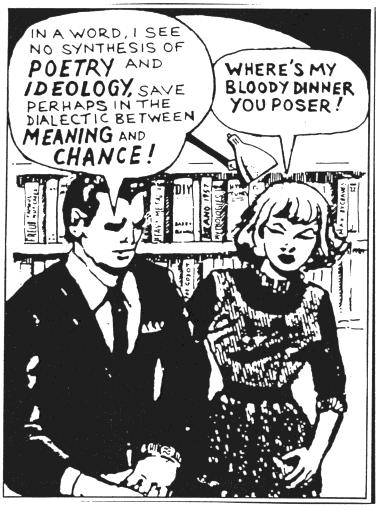
poser

Responding to Michael Sinding:

Your points are well taken, Michael.  And it is true that in the comparatively small Frye community, it is easy enough to find a measure of regret about how things have spun out over the last 30 years or so.  Speaking for myself, I was an undergrad when the revolution was fully under way, and I watched as it swept everything out of its path in very short order by appealing to the worst in the academic character, especially the sense of superiority and entitlement.  When I returned years later as a grad student, it was easy to see what had been lost and at what cost.  In your post you describe what sound like small gains — the return of a measure of sanity here and there in an intellectual landscape that has been otherwise ravaged (as you put it at one point, by people who were “brilliant” but “wrong”).  The result is that it’s almost like we are called upon to rediscover fire and reinvent the wheel.  It’s not that there are no good ideas out there, it’s that they do not really compensate for the bad ones that have caused a whole generation of scholars to behave as though, if not actually believe that, literature has no value in itself.  That’s always what set Frye apart: his sure understanding that literature is autonomous and possesses its own unique authority — and, yeah, that authority is “timeless” in the sense that it is constant, even as the literary imagination omnivorously reprocesses whatever cultural, sociological, ideological and historical phenomena that confront it.  I can’t think of anyone else who comes close to asserting as much so consistently, let alone expressing it comprehensively in an extended body of work.

One last point: Frye was not merely superseded during the post-structuralist realignment, he was pushed aside with what can only be taken as shows of bad faith through misreading and misrepresentation.  Russell Perkin’s citation yesterday of Frye’s note to Bob Denham on the enumerative bibliography illustrates the point nicely.  Frye, of course, saw what was going on and often seemed baffled by it, as though he believed that at any moment people would regain their senses.  In one of the late notebooks, he wonders with uncharacteristic despair, “Why am I so revered but so ignored?”  Why indeed?  Frye was a much more revolutionary literary theorist than any who succeeded him because, unlike them, he drew upon the authority of literature itself, knowing that the literary is primary and other verbal structures are secondary derivations.  Like the derivative “instruments” that almost collapsed the financial system last year, the derivative “discourse” of the last generation has denied the public its birthright: the responsible management of an imaginative heritage that not only confronts social injustice in unmistakable terms but empowers us to overcome it.  We need only accept the invitation our shared heritage extends, and to do that we have to recognize the nature of the invitation being offered.  Frye was able to do this — and able to express it in a way that inspires others, as Bob’s post of student testimonials today suggests.  As it turned out, not many other theorists could do the same, and what they couldn’t do became the basis of what literary scholarship was subsequently obliged to do.

Thanks to Clayton Chrusch

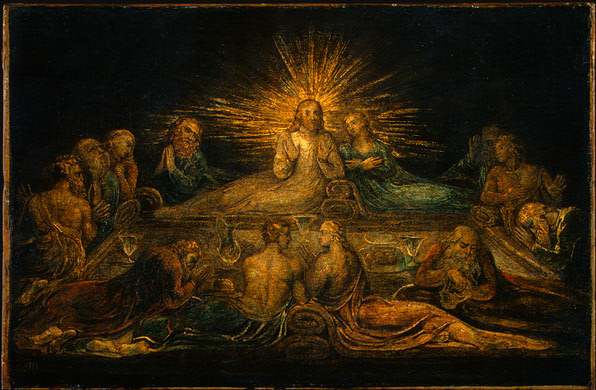
blake-the-last-supper

Fearful Symmetry was the very last of Frye’s major works that I read, and by the time I  first read it, I had re-read just about everything else a few times over. I don’t know why I put it off for so long. I rationalized that it is a youthful work (even though it is clearly not that), a mere precursor to Anatomy where the “real work” begins, and a study narrowly focused on a still somewhat obscure poet. So, predictably enough, when I finally came to read it, it blew open all the doors and sent my carefully arranged mental furniture flying. It’s a book that still haunts me. Fearful Symmetry possesses all of Frye’s runic power to summon up the fearsome but benign authority of the Magus/prophet: not, as he says elsewhere, the oppressive mystery that conceals, but the liberating mystery that reveals.

I am therefore very grateful that Clayton Chrusch has undertaken to provide us with a weekly summary, chapter by chapter. By the time I reach the end of each installment, I’m a little breathless with excitement. Such is the power of the book that Clayton’s lucid exposition effortlessly taps into it. I look forward to his next.