Glenn Gould playing the Goldberg Variations, Aria.
httpv://www.youtube.com/watch?v=Gv94m_S3QDo
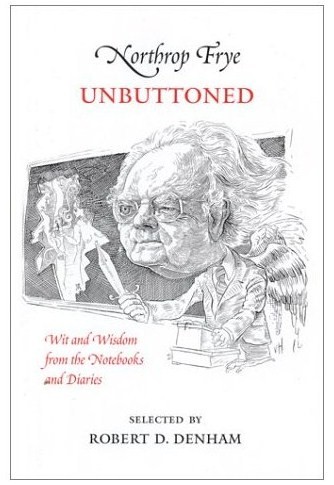
Bob Denham has compiled a list of Frye’s “superlatives” — his own personal “best of” list. While his categories and picks are always enlightening, I’m sure just about everyone will find a surprise or two.
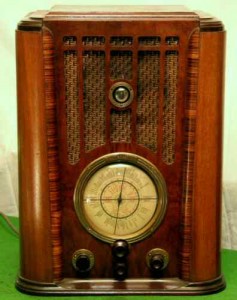
1942: The shape of things to come…
[97] Listened to Information Please programme last night. I wonder what the popular appeal of that programme is based on: I think partly on the enormous prestige enjoyed by a man who is well-informed on non-controversial subjects. The amount of actual erudition [John] Kieran gets a chance to display is not impressive, as such things go, but shuch things go a long way, like the polysyllables of Goldsmith‘s schoolmaster [The Deserted Village, l. 213: Ed. “While words of learned length and thundering sound”]. By means of it I succeeded in scaring the shit out of [Bobby] Morrison and Beattie, who make three times the money I do. One doesn’t realilze the immense social prestige of the university until one gets a little outside of it. Speaking of them, I wonder if the dry rot at the basis of their lives is significant of an economic change in which the bustling, successful, money-making, super-selling young man is no longer a pure clear-eyed Alger hero but an embittered souse.
1950: Some inconsequential gossip as the new school year begins.

1942: Frye is perhaps giving some hint of the woe that is in marriage: he and Helen certainly seem to be feeling the conflict between marriage and career, Helen especially.
[96] Mary Louise & Peter [Cameron] got married today, by Betty [MacCree’s] father, who did an awful job but let me out. I hate wedding receptions, & the only thing the service reminds me of is that “for fairer, for loather” was the original form of “for better, for worse.” Helen probing to see how much Jerry’s house would cost us to live in: too much. Helen’s been restless lately: the war gives her claustrophobia & she has the feeling that everyone else is doing something more interesting. Jerry [Riddell] going to Ottawa to take a government job, Eleanor [Godfrey] being mysterious about a career in advertising or publicity or something & taking a trip, Mary [Winspear] going out to Edmonton to be Dean of women, Beattie collecting a salary of $6100 a year: with my hopeless non-essential background she feels that everyone’s playing a game she’s left out of.
1950: No entry.

Clayton Chrusch’s comment on Ian Sloan’s post about Frye and Hawken deserves to be brought forward:
I really appreciate this post because it questions how Frye can be personally and socially relevant, which is what I am concerned about.
Here is my take, based on my limited understanding of Frye.
I think one of Frye’s contributions is as an historian of the imaginaton (that’s not quite the right term, since Frye does not try to make a rigourous historical case for anything). He gives a historical-imaginative context for the kind of changes he and Paul Hawken are describing. In particular, he sees people’s imaginations as being shaped by imaginative cosmologies. By cosmology, he meant simple mental pictures, almost diagrams, that structure almost everything about how we imagine the world. There have been two cosmologies historically (Blake was the prophet of the second one but he also saw beyond it) and Frye suggested that third was on the way. All three can be traced to the Bible.
My understanding is that the first two are vertical cosmologies. The first is the authoritarian cosmology with god/father/king figure and all legitimate authority at the top and the devil/child/slave, and everything legitimately subject to authority at the bottom.
The second is the revolutionary cosmology and it is formally a parody of the first, where the figure at the top is seen as as a tyrant or a fool and the bottom is reservoir of creative (and destructive) energy. The second cosmology informed Freud’s view of the subconscious, and Marx’s view of the proletariat. Frye also mentions Nietzche here. So all the dominant worldviews of the 20th century come out of ideas developed in the 19th-early 20th century, having their origin in this major cosmological shift heralded by Blake at the end of the 18th.
Frye saw the third cosmology as interpenetrative, an Indra’s net where connectedness, identity, and equality within the context of incredible diversity replace the dominance, alienation, inequality, and uniformity of the first two cosmologies. It is a non-ideological cosmology because it is not hierarchical. Because it is non-ideological, it can make primary concerns truly primary.
If I had to make a judgement on the interpenetrative cosmology, I would say that we haven’t discovered its full potential yet, but it is hard for me to believe it is a new mold in which all of our imaginative structures from now on can be formed. I think we still need the first two cosmologies as well as the third. But because the third is new, it will be the source of real and good imaginative innovations that we have not yet seen.
I haven’t read the book by Paul Hawken, but perhaps he is one of these innovators.
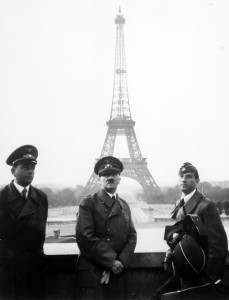
1942: Reflections on the war, which again, is not going well for the allies: the disaster of the Dieppe Raid on August 19th is becoming increasingly apparent.
[95] Anniversary of the war, so we’re told: see Aug. 19. It occurred to me a short while ago that I never really considered the possibility of our losing the war. I mean by that that I had never sat down and figured out how I could conscientiously go on living if we did. I’m beginning to understand how paralyzed, hopeless, hag-ridden and stupefied the average intellectual anti-Nazi on the European continent must be — have been.
1950: No entry.
1942:
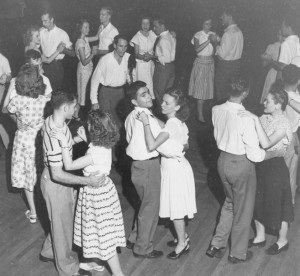
[92] The radio is going: why is so much dance music thin, wailing, dismally melancholy and wistful, like a train going through a forest at night? [Ed. represented by a classic at the above link.] Is it intended to reproduce the complaining of the libido? Certainly it’s aimed at below the waist, & suited to a dimly lit dance hall with adolescents shuffling up & down the floor rhythmically rubbing their genitals together.
[93] I’m acquiring too many vulgar expressions, like bum’s rush for W.C. & cowflop for female wallflower.
1950: No entries for September 2, 3, 4.
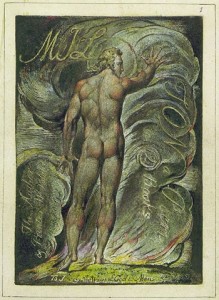
Clayton Chrusch draws our attention to LibriVox — “accoustical liberation of books in the public domain” — where there is a new recording of Blake’s Milton: http://librivox.org/milton-a-poem-by-william-blake/

1942: Frye loses access to the medication that offers relief for his chronic hay fever. He therefore unleashes against the medical profession.
[91]… My druggest tells me that a new drug act has passed preventing several drugs, including codeine and phenobarbol [phenobarbitol], to be sold over the counter without a doctor’s prescription, thus greatly reducing the effectiveness of such potent medicines as the one that’s helping me. Sounds like a medical stranglehold on their apothecary enemies of 3000 yrs. There may be a lot to be said on both sides, but doctors today are such ignorant barbarians, & their sense of heresy is priestly rather than scientific.
1950: The Frye’s move into the Brattle Inn on Story Street, just off of Harvard Square. John Ayre in his biography describes it “a glorified boarding house where they ate on a card table and washed their dishes in the bathtub” (226). (A house in the Brattle/Story Street neighborhood is pictured above.)
[586] Today we completed our move to Story Street… [T]he place is much better set up for working than the house was: it has an excellent desk and a place to put books. It was hot & we got tired quickly: I did actually most of the unpacking in the evening… Mrs. Baillio…continues to be a dear; they’ve put up a new double bed in the place of the twin beds they had before; they’ve moved in new furniture (two enormous easy chairs, one a rocker), & in general I think we’ll live comfortably, if not luxuriously.
I was in Bryan Prince Books today where I got talking with Tracey, one of the helpful and knowledgable staff, who had just read Alice Munro‘s Lives of Girls and Women and loved it. (Munro’s latest, Too Much Happiness is now out and available at Bryan Prince Books — that’s Bryan Prince Books, located in the heart of Westdale Village, Hamilton.) I confessed that I actively prosyletize for three people: Shakespeare, Frye, and Munro. Tracey said that she’d been meaning to read Frye, and I of course told her about us — at which point the man standing behind us piped up, “It’s a good blog.” This gracious young man, whom I’ll call “Matthew” (in fact his real name), assured me that he’d been reading the blog since it first appeared two weeks ago, and that he knows others who are reading it too. (He’s also a Munro fan: coincidence?) I can’t pretend I wasn’t delighted by this chance meeting–and, of course, a high end cultural establishment like Bryan Prince Books offers the best chance of such a meeting. I’m also going to assume that this single encounter is representative of the thousands if not millions of anonymous readers out there who visit us daily. Bless you all. Godspeed. May the road rise to meet you.
However, let me ask you what I asked “Matthew”: Why not come out from the shadows? We’d love to hear from you. Submit a Comment or send us a post via email on any marginally Frye-related topic. We’ll gladly put it up.