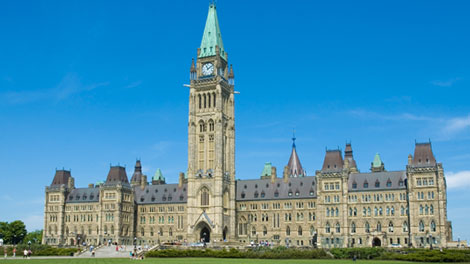
Early Voting: What Does It Mean?

httpv://www.youtube.com/watch?v=1aBaX9GPSaQ

Easily the funniest Simpson’s bit in more than a decade: Homer tries to vote for Obama on a rigged voting machine.  (Click on the image above and hit the YouTube link.)

Michael P. McDonald has posted the numbers for early voting in the midterms.  It’s a complex situation with lots of variables, but the Democrats seem to enjoy the edge for those opting to vote early, which may be a good sign for overall voter turnout.  I have seen suggestions that this phenomenon may be the Obama effect: his campaigning has been strong enough that he’s put people in the mood to vote early; particularly because, as we know, long lines seem always to occur exclusively in Democratic districts on election day, and that people of color are more susceptible to some form of harassment by local and state police when they try to get to the polls.  As McDonald points out, this does not necessarily mean that Democrats will prevail on election day, but that it might not be the bloodletting that has Republicans smacking their lips.

A sample from McDonald’s article:

We appear to have entered a new era of early voting where Democrats are the ones more likely to vote early. The 2010 early voting numbers are better for Democrats than 2006 but are better for Republicans than 2008. Not surprisingly, Democrats are comparing the current numbers to 2006 while Republicans are comparing to 2008. We are likely somewhere in-between 2006 and 2008, but we do not know by how much, which leaves ample room for both parties to spin.

If voting behavior changed in 2010, a hanging question is why? Why would Democrats now be of the type more likely to vote early? I offer two plausible explanations. First, that Democrats learned about early voting options in their state and like using it. This may be particularly true for states that offer in-person early voting at special polling places, since there is plenty of evidence that this is the favored voting method for Democrats. Second, that Democrats developed early voter mobilization organizations in 2008 that they are carrying forward to 2010. I suspect both explanations contribute to the story.
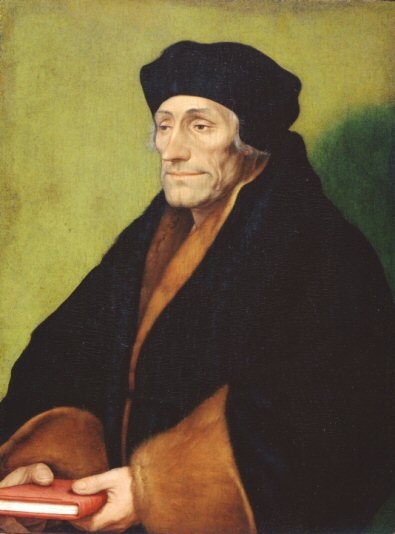
Erasmus

Today is Dutch humanist and theologian Erasmus‘ birthday (1466-1536).

Frye in The Great Code on Erasmus and the always troublesome interpretation of the Gospel of John’s “In the beginning was the Word”:

Erasmus, in the Latin translation appended to his edition of the Greek New Testament, renders “In the beginning was the Word” as “In principio erat sermo.”  This is purely a metonymic translation: in the beginning, Erasmus assumes, was the infinite mind, with its interlocking thoughts and ideas out of which the creative words emerged.  Erasmus is clearly more influenced than [St.] Jerome by the later Greek history of the word [i.e. logos].  It would be cheap parody to say that Erasmus really means “In the beginning was continuous prose,” but the link between his “sermo” and the development of continuous prose is there nonetheless. (18)

GOPocalypse Now?

The conventional wisdom, now shrieking around the globe like a Category Five hurricane, is that on November 2nd the Republicans will sweep to victory on a tsunami of voter discontent: a 40, 50, 60 seat gain in the House alone!  Pick a number.  Any number.  They’ve all been cited.

But there are indications to the contrary that seem to be pointedly overlooked  — which is a recognizable pattern of behavior once the mainstream media has latched onto a narrative it can credibly live with.

First, Obama’s approval ratings are up sharply as he’s worked the campaign trail, and are in fact 12 points higher than Reagan’s were at the same point in his presidency.

Second, there is a new Newsweek poll suggesting that the Democrats are ahead on a generic ballot involving likely voters.  Many are dismissing the poll as an outlier, and perhaps they’re right to, but here’s the rub:  of all the recent polls that feed the frenzy of foregone conclusion, only the Newsweek poll includes a sample of cell phone-only users.

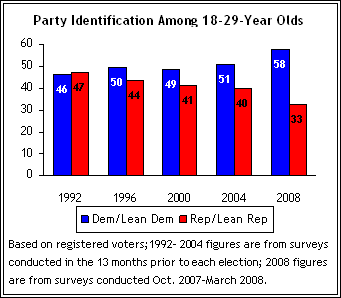
It’s no secret what the significance of this factor is, even though it is largely ignored.  Those who use cell phones exclusively tend to be young, urban and liberal.  If the Newsweek poll turns out to be in play, then it may help to expose a deeply entrenched polling bias that the purveyors of conventional wisdom seem unwilling to address in any consistent way.  It’s a kind of low-grade, passive-aggressive voter suppression of a key demographic group, which is systematically excluded from the polling data because enough people have decided it doesn’t really count.  Here’s hoping these young voters overturn the conventional wisdom and reshape it into something that resembles the actual will of the people and not just the wildly careening spin of corporate interests.

Georges Jacques Danton

httpv://www.youtube.com/watch?v=S20eTvkahrQ

The execution of Danton from the 1983 biopic.  French with English subtitles

Today is the birthday of Danton, French revolutionary leader of the Jacobins (1759-1794).  As with many in the revolutionary leadership, it did not end well: Danton went the guillotine in 1794, saying to his executioner, “Don’t forget to show my head to the people. It’s well worth seeing.”

Frye citing Edmund Burke on the Jacobins and the Terror in A Study of English Romanticism:

Coleridge was more belligerently Christian in insisting that the primary imagination was an existence repeating the infinite “I am” of God, and in feeling that every argument he advanced on the point was one in the eye for atheism, scepticism, and “psilanthropism.”  In Burke we see, much more clearly than in Coleridge, that this new sense of [romantic] identity does have a real enemy.  Burke identifies the enemy with the Jacobinism of the French Revolution.  Burke’s view of the French Revolution itself, however, is not very rewarding: what is important is his prophetic vision of the kind of society where the sense of the continuity of tradition is annihilated, and where the general will of society is unconditioned by any reference to a goal beyond the immediate objects of those in power.  (CW 17, 203-4)

Quote of the Day: “How good a scholar is he?”

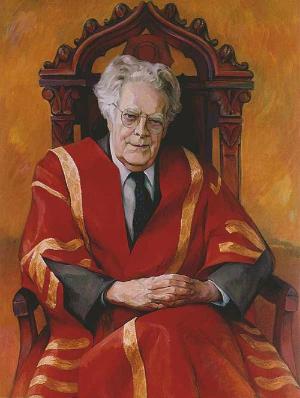
Frye in his robes as Chancellor of Victoria University.

Here’s a quote from Frye I hope academic administrators everywhere might think about.

“When anyone is considered for a deanship or a presidency, one of the first questions asked about him is, ‘How good a scholar is he?’ It sounds absurd to associate a man’s administrative ability with his specialized knowledge of a scholarly discipline, but the question is relevant none the less. If he has never been a scholar, he doesn’t know what a university is or what it stands for, and if he doesn’t know that, God help the university that gives him a responsible job.” (CW 7, 314)

Geoffrey Chaucer

httpv://www.youtube.com/watch?v=KxmUOJWisds

On this date Geoffrey Chaucer died (c. 1342-1400).

From Frye’s student paper, “A Reconsideration of Chaucer” (written and revised ca. 1936-1938):

We shall come to this question of Chaucer’s religious attitude again: all we are concerned with just now is the fact that the half-century between the Black Death and the death of Chaucer is a cultural unity as much as the baroque, rococo, or Victorian periods are.  The inner conflicts are intense, but they are a sign of vitality, and from one very significant point of view the resemblances are more profound and significant than the differences.  It is an error of fact to call Langland a Lollard or a sympathizer with John Ball; but it is not an error of interpretation to see underlying connections among all three.  Such a method of approach to any age in history is concerned above all to examine that age as far as humanly possible in terms of its own standards.  We have had enough, for example, of the critic who ascribes to Chaucer a sneaking sympathy with the ideas of Voltaire because the critic himself is revolting agains a Yahwistic mother.  Even more responsible criticism is apt to assume an impossible antithesis between “medieval” and “modern” attitudes, in which case it is not difficult to prove that Chaucer was “essentially” either.  Chaucer is not “essentially” anything but Chaucer, however, and Chaucer lived in the age of Wycliffe and Langland.  At the same time it is undoubtedly true that he is a uniquely cosmopolitan figure.  He drew both from the humanistic Italy of Petrarch and Boccaccio and from the still feudal and medieval France of Jean de Meung.  The cultural unity of fourteenth-century England is expressed very well by Langland and Wycliffe; but if we want to see this period in its relation to European culture as a whole we have to turn to Chaucer. (CW 3, 435)