Author Archives: Michael Happy

Friday Night Dance Party

httpv://www.youtube.com/watch?v=leohcvmf8kM

It’s January.  January.  The worst month of the year, which is then followed by the second worst month of the year — February.

Oy.  That’s a tough go.

At times like these we need cheer wherever we can find it.  We’ve usually put the weekends aside for Frye-related videos of some sort, but dark times call for, oh, I dunno, a Hawaiian themed party with Twister, drinking games and tequila body shots!

And just who would you want providing the music for such a party?  Why, only a self-described “tacky little dance band from Athens, Georgia” is who!  The one and only B52s.

The video above represents the apex of their commercial success, and the message, appropriately enough, is love.

For those who prefer their B52s a little less cute and cuddly, who remember how genuinely weird they were when they first broke onto the scene, there are some goodies for you after the jump.  Selected for maximum Frye-relevancy.

Continue reading

Extra-Rational Exuberance

httpv://www.youtube.com/watch?v=icGOLDJv08c

Thanks to the recent addition of our new byline correspondents and an extraordinarily good week of extraordinarily good posts, I am experiencing (to tweak Alan Greenspan’s famous formulation) a surge of extra-rational exuberance.

There’s no accounting for taste, of course, although there can at least be an accounting of it.  All of the arts provide us an opportunity to feel — to know! — that the world can be changed for the better, and we find our private anthems where we can.  Here’s one I’ve been hitting the replay button on all day; from the Cold War depths of the Reagan era and the Golden Age of Indie Rock, REM’s “Radio Free Europe”  I can’t be the only person who hears Peter Buck’s joyfully pealing arpeggios and feels the involuntary pleasure of knowing that I am both free and have some very hard work to do.

Calling all in transit / Calling all in transit . . .

Shakespeare, Frye & Ideology

SANDERS2s

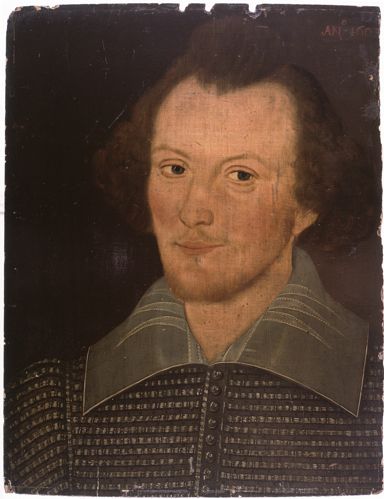
The “Sanders portrait,” the “Canadian” Shakespeare unveiled in 2001, purportedly painted from life in 1603.

Russell’s post on Greene and Shakespeare raises a number of questions about the relation between literature and ideology — a subject that has always been at the centre of literary criticism and shows no sign of going away.

Frye, in a display of irreverence as cheeky as Greene’s, famously observed (referring both to the relatively thin biography and the posthumously published Droeshout portrait) that we have very little hard data about Shakespeare: a few signatures, a handful of addresses, “and the portrait of a man who is clearly an idiot.”  As Russell points out, Frye is always able to make a distinction between the “man” (who may possess idiotic personal qualities and even more idiotic ideological views) and the “writer.” For current critical theory and practice, this must seem an indefensible position.  How is it possible for anyone to produce work independent of their all-encompassing social conditioning and the prejudices it spawns?

For Frye, the answer begins with the fact that literature possesses both “autonomy” and an “authority” unique to it.  Literary archetypes — whose universality can be discerned by the widest possible inductive survey of literature throughout history and across cultures — are expressive of imaginative constants and primary existential concerns.  Moreover, the context is fundamentally different.  Language in its everyday social function is “work”: expressing beliefs, necessities, truths, and so on.  Literary structures, on the other hand, are, in their imaginatively recreational function, “play”: they “exist for their own sake” and provide no requirement of belief or claim to truth.   Ideology, in short, compels; literature invites.  And upon that distinction everything follows, including the fact that the writer (like, say,  T.S. Eliot, about whom Frye directly addresses this very issue) may be consciously pushing a personal ideological agenda from which the literature itself displays a stubbornly independent purpose.  This is why literature is potentially “visionary”: it provides us with a clarified sense of what we want and who we would like to be without providing any compulsory program of action or belief.  Literature as recreation merely provides the opportunity for re-creation; it does not and cannot compel it.  What we choose to do in response to the existentially concerned but still aesthetic experience of literature is always entirely up to us, including (as we know all too well) doing absolutely nothing at all.

Frye more or less takes up these issues in the opening pages of the Introduction to On Shakespeare.  In fact, here is the complete second paragraph of that Introduction:

We have to keep the historical Shakespeare always present in our minds to prevent us from trying to kidnap him into our own cultural orbit, which is different from but quite as narrow as that of Shakespeare’s first audiences.   For instance, we get obsessed by the notion of using words to manipulate people and events, of the importance of saying things. If we were Shakespeare, we may feel, we wouldn’t write an anti-Semitic play like The Merchant of Venice, or a sexist play like The Taming of the Shrew, or a knockabout farce like The Merry Wives of Windsor, or a brutal melodrama like Titus Andronicus. That is, we’d have used the drama for higher and nobler purposes. One of the first points to get clear about Shakespeare is that he didn’t use the drama for anything: he entered into its conditions as they were then, and accepted them totally. That fact has everything to do with his rank as a poet now.  (On Shakespeare, 1-2)

So what does Shakespeare’s “rank as a poet” really amount to?  It may be summed up by the fact that he does not ever subordinate the autonomy and authority of his art to any external consideration: “all the world’s a stage” is not just a clever conceit in Shakespeare, it is a radical metaphor of his imaginative worldview. As Frye puts it, “In every play Shakespeare wrote, the hero or central character is the theatre itself” (OS 4). He may reflect the beliefs, biases, anxieties and prejudices of his time in a way his audience might recognize and even approve of, but he doesn’t promote them.  The Merchant of Venice is nowhere close to reducible to the anti-Semitism it conjures; The Taming of the Shrew overturns the complacent sexism it renders; The Merry Wives of Windsor unexpectedly offers up a more egalitarian and tolerant vision of society once the knockabout farce has played itself out; and Titus Andronicus proves to be a powerful meditation upon the grisly absurdity of the human capacity for cruelty. Why? Because Shakespeare allows his plays to play without ever feeling the necessity of putting them to work in the name of some ideology, however noble or well-intentioned it may otherwise claim to be.
Saturday Night at the Movies: “The Third Man”

httpv://www.youtube.com/watch?v=un26BBFQ5_M

Russell Perkin has already posted on Graham Greene and Frye and evidently will be doing so again soon with something on “Shakespeare, Greene and ideology.”  This seems like a good time, therefore, to feature a movie written by Greene, enjoyed by Frye, and now of course regarded as a classic in its own right: The Third Man.

In his diary entry for April 26, 1950, Frye records having seen the movie with Helen the night before and describes it as “very good’:

The musical accompaniment — a zither playing the same series of chords over & over — was very effective, & the whole atmosphere of post-war Vienna, its spirit broken by occupation & its poverty grinding everyone down to a squalid sort of mutual prostitution, was horribly convincing. The villain, done by Orson Welles himself, was the type Hollywood movies generally idealize — a cheerful, handsome, appealing boy who was a complete psychopath, & the curiously empty & helpless horror that such a character inspires came through in a magnificent scene — the only one where he said anything — on a Ferris wheel with the American hero [Joseph Cotten], whose inept honesty made just the right foil. The ferocity of the heroine’s devotion [Alida Valli] to the man whom she knew had betrayed her tied up what was really a pretty grim story, for all the melodramatic chase-through-the-sewers that made it more reassuring for the young women behind us.

It’s funny now that Frye turns his nose up at the “melodramatic chase-through-the-sewers.”  At the very least it proves that he did not reflexively fall into archetype spotting simply because it might niftily prove a point.  Every Frygian since would recognize the sequence as a nicely framed descent into the underworld, and all no doubt sooner or later comment on it.  Furthermore, this particular “melodramatic chase” is artful and modest compared to the Wagnerian tumescence of the formula as it is rendered these days.  Over Christmas I went with my neighbors and their kids to see Avatar.  For the first 90 minutes I was enchanted by it — in terms of cinematic art and technology, it is undeniably a watershed — and I considered posting on it in the context of Frye’s observations about how comprehensive an art form the movies actually are.  But, oh my, then the formula kicked in (this is a James Cameron movie after all, the director who included a chase scene on the sinking Titanic in which gunshots are fired), and all of the care and ingenuity that went into creating the world of Pandora in 3D sickeningly descended for almost a full hour into a futuristic hightech blood letting.  It was like falling out of love and waking up cold and hungover all at once.  I joked to my friends afterwards, if only Cameron believed in the movie he’d been making up to that point.  If every life is precious (as Avatar unrelentingly insists), then why was so much of it so readily expendable?

In any event, The Third Man is literarily grounded popular film making at its best: smart with a sharp tongue and a sound ear and at least a couple of unexpected moments of cinematic genius.