Author Archives: Michael Happy

Quote of the Day

murdochailes

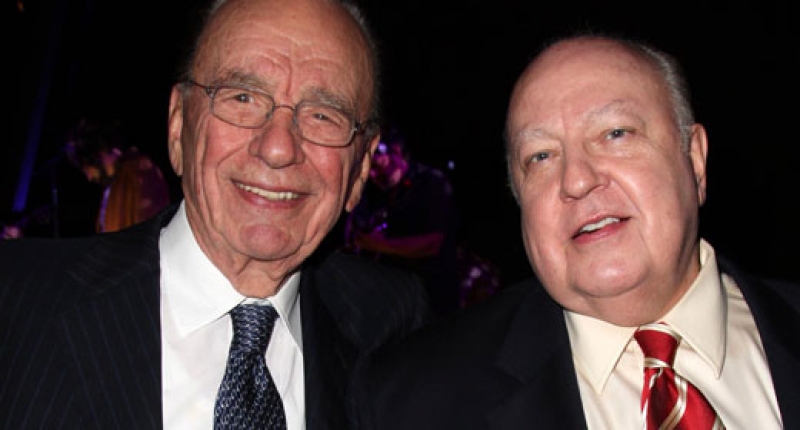
Rupert Murdoch and Roger Ailes

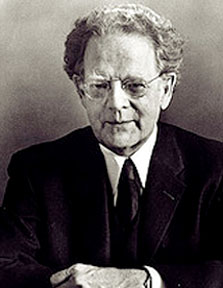
“The American fascist would prefer not to use violence. His method is to poison the channels of public information. With a fascist the problem is never how best to present the truth to the public but how best to use the news to deceive the public into giving the fascist and his group more money or more power.”

Vice President Henry A. Wallace, New York Times, April 9, 1944


Frye on Fascism and Communism

frye-2

In “The Present Condition of Society” (1943):

It was inevitable that those who saw most clearly that there was much in American life heading straight for Nazism, and who were still looking for something which should be definitely anti-Nazi enough and still consistent with deism, should have found what they were looking for in the Communists.  (CW 10, 219)

In 1949 Diary (Jan. 28):

Many well-meaning and gentle people suffer from a vicious streak of masochism–they feel helpless in the midst of a brutal society, & in some warped way they want to feel so: they like saying they can’t do anything about, say, the American hold on Canada, or say it with a significant grin.  In the last decade they helped the rise of fascism, & now they show a sneaking fondness for communism because of the nihilistic element in it.  (CW 8, 104)

In “Trends in Modern Culture” (1952):

Fascism is an oligarchic conspiracy against the open-class system, deriving its real power from the big oligarchs and its mass support from would-be oligarchs, the “independent” (i.e. unsuccessful) entrepreneurs.  Communism is the corresponding conspiracy on the other end, addressing itself to those most likely to feel that society in its present form will permanently exclude them from its benefits. (CW 11, 252)

In T. S. Eliot (1963):

Fascism and Communism are the products of strong tendencies within democracy itself, and our horror at these products springs from the ego’s dislike of inconvenience rather than love of freedom. (CW 29, 188)

In the “Foreward to 1984″ (1967):

In [Orwell’s] writings on Spain, particularly Homage to Catalonia, he shows how like in aim and motivation Russian Communism was to the Fascism it in theory opposed. (ibid., 278)

Frye Alert

alice munro northropfrye02

CSU Long Beach Professor Emeritus Charles May has posted his paper on Alice Munro that cites Frye on Romance.  He delivered it at the 11th International Short Story Conference in Toronto earlier this month.  You can read it at his blog here.

Video of the Day

httpv://www.youtube.com/watch?v=nJVNnAIrLkM

Kory Teneycke, former communications director for Stephen Harper now working for Brian Mulroney as Quebecor’s point man on “Fox News North,” interviewed on the CBC where until recently he was a commentator for the right.

Offered without comment.

However, I will repeat this comment left about the video at YouTube: “Does EVERY right-winger have to lie to make a point?”

John Skelton

skelton

On this date John Skelton died (1460-1529).

Frye in Recontre: The General Editor’s Introduction”:

As a result of the change of rhythm, the native four-beat line came into the foreground again.  At the court of Henry VIII, John Skelton developed the “skeltonic” rhythm which has been named after him, a rhythm closer to nursery rhyme, ballad, and popular poetry of all kinds than perhaps any other equally important poet has produced.  One result of this, of a type not uncommon among experimental poets, was that it was not until well on in the twentieth century that he was regarded as an important poet at all.  The English four-beat line was, we said, split in two by a mid-line caesura; hence Old English poetry could be printed as a series to two-beat lines by a slight change in typography.  The skeltonic is rhythmically the Old English half-line revived, although a clanging rhythm has been added:

For though my rhyme be ragged,

Tattered and jagged,

Rudely rain-beaten,

Rusty and moth-eaten,

If ye take well therewith,

It hath in it some pith.  [Colin Clout II. 53-8]

Such a rhythm is logical, if extreme, of accentual tendencies, and is an excellent vehicle for the violent satire and grotesque realism that usually accompanied it in Skelton.  (CW 10, 14)

Frye’s “Closed Mythology” of Authoritarianism

httpv://www.youtube.com/watch?v=wPELTY6vSqk

Former Nixon aide John Dean talks about “proto-fascist tendencies” in the Bush administration and the Republican party

There is a lot of discussion these days among concerned old-school American conservatives about the “epistemic closure” that has become so apparent in the Rush Limbaugh-Fox News universe; that what now passes for conservatism in America is actually an antic form of nihilism that believes in nothing but obtaining and holding on to power at any cost.  Its chief weapons are the propagation of lies, confusion, fear, and resentment.  It is notable that two of the leading voices on the issue of epistemic closure are not American born and raised: one’s an ex-pat Brit, Andrew Sullivan, and the other an ex-pat Canadian, David Frum — both from countries with a strong, moderating Tory tradition.

I was a little disappointed to find that Frye evidently has nothing to say about Theodor Adorno and his notion of the “authoritarian personality,” but that doesn’t mean we shouldn’t at least glance at how Adorno and his co-authors frame the issue. The traits of the authoritarian personality are common and readily identifiable.  Those traits are:  “conventionalism, authoritarian submission, authoritarian aggression, anti-intraception, superstition and stereotypy, power and “toughness,” destructiveness and cynicism, projectivity, and exaggerated concerns over sexuality (sexual repression).”  The authoritarian personality is therefore highly predisposed to follow the dictates of a strong leader and traditional, conventional values.

Does this really require much elaboration?  We see these symptoms being played out on the right every day, and the further right you go, the more pathological the behavior becomes.  Take just one example, “exaggerated concerns over sexuality (sexual repression).”  It has become part of our satirical lore over the last few years that, the more homophobic the Republican/conservative/evangelical leader is, the more likely he will be outed for engaging in closeted homosexual activity (nicely bringing the principle of “projectivity” into play).  The list is too long and the details too sad to bother lingering over.  But if you are somehow unaware of the phenomenon, here’s a short list of some of the more notorious figures: Rev. Ted Haggard, Sen. Larry Craig, Dr. and Rev. George Rekers.  They’ve added to our lexicon phrases such as “wide stance” and “long stroke.”  The case of Rekers, the most recent outing, is especially disturbing because he’s both a psychiatrist and a minister — as well as the co-founder of the repulsive Family Research Council — who for decades has claimed that homosexuality is a psychological disorder that can be treated and “cured.”  In May he was spotted returning from a ten day European vacation with a 20 year old male prostitute who confirmed sexual relations with Rekers.

The self-destructiveness of the authoritarian personality would be a matter of pity if it weren’t so devastating in its wider social implications.  The epistemic closure of the authoritarian mindset will collapse in on itself eventually — but, as demonstrated by the recent world-wide financial meltdown brought about by derivative instruments designed ultimately only to make money for the brokers, the wider public is not necessarily spared the consequences.

Frye has his own version of epistemic closure, which in The Modern Century he calls a “closed mythology”:

Continue reading

Oxford

merton_college_oxford_3059

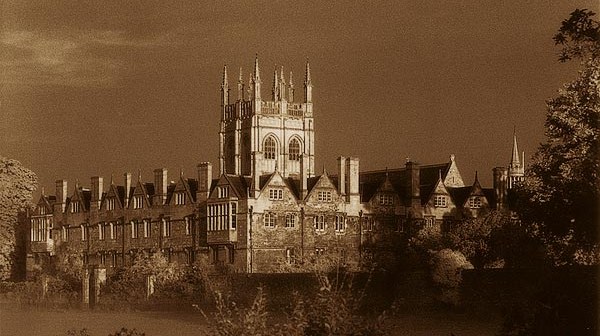
Merton College, Oxford

On this date in 1214 The University of Oxford received its charter.

Frye attended Merton College (established 1264), completing his studies for an MA in the spring of 1939.  During the summer and fall of 1982 Frye was interviewed by Valerie Schatzker as part of an oral history of the University of Toronto.  Here he talks about his experience at Oxford.

Schaztker: How did [study there] compare with what you remember from the Honour Course [at Victoria College]?

Frye: It was very largely a repetition of what I’d done.  I read more intensively, but, as I said, my real reason for taking it was that I wanted to become fresher in the whole English area.  If you ask about instruction: of course it was tutorial, and my tutor was Edmund Blunden, who was a rather shy, diffident man.  For some bloody reason, which I’ve never figured out, he was pro-Nazi.  I didn’t know who was to blame for that.  But in any case, I seemed to meet fascists everywhere I turned at Oxford, so I was poltically and socially extremely unhappy for that time that I was there.  England’s morale seemed to be the lowest in its history.  If you read Howard K. Smith’s Last Train From Berlin (he’s a CBS announcer, and he was a classmate of mine at Oxford), the first chapter is about his experiences at Merton College and it will give you some idea of what I myself found extremely uncongenial about the place…

It may have been pure accident.  But if I found myself just meeting people casually, I seemed to keep running into fascist groups all the time.  I knew that the Labour group was the largest single group at Oxford, but the general feeling at Merton, certainly, and I think at several other colleges as well, was very much not to my liking…

I wouldn’t say that it was more politially active, but the undercurrents were beginning to swirl around and they were very ugly ones.  There was one man who had gone up to Merton on a scholarship which had been donated by Oswald Mosely [of the British Union of Fascists] and his job was to recruit people as far as he could.  I felt that if England had not been forced into an anti-Hitler position it would have gone in a very sinister direction or at least the intellectual leadership would have done so.

Schatzker: Did you find yourself ostracized?

Frye: No, I didn’t.  That’s too strong a word.  I didn’t find myself ostrasized.  And of course there were very intense left-wing people both in Merton College and elsewhere.  Howard Smith was one, and another was a tough egg from Yorkshire who came home drunk to his room and found four or five Fascists roughing it up.  So his head cleared and he went into action and pretty soon the air was thick with Fascists flying out of windows. (CW 24, 599-600)
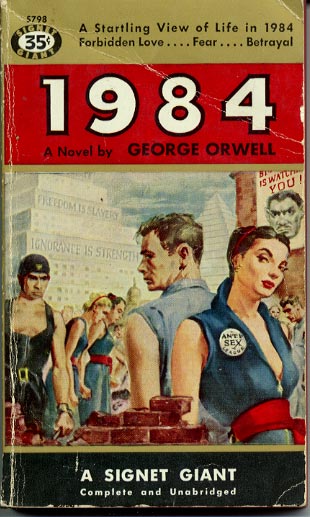
Quote of the Day: Frye on “1984”

1984

From the “Foreward to 1984″ (1967):

“It would be a great mistake to assume that 1984 simply exhibits Communism to us like a monkey cage in a zoo, with the aim of making us feel more complacent about our superior liberties.  The book shows us not a monkey cage but a mirror.  Its society is the logical form of what a great many of us have already shown that we want.  One of the things that most disgusted Orwell was the masochism of some of the intellectuals around him, who thought that any totalitarian government was better than democracy because it was more logical.  Those who were pro-Communist ignored or explained away all the evidence that Stalin’s government was brutal, corrupt, and treacherous.  In other words they were willing to rewrite history in terms of their own prejudices.  The history incorporated into 1984 remarks that most of the intellectuals in the democracies had become authoritarian by 1940, and there is far too much truth in that statement.  Or, again, take McCarthyism, something that grew up after Orwell’s book.  I have read many letters in American papers defending McCarthy, and what most of them said in effect was: “Communism is such a danger that it doesn’t matter if his accusations are true or not; how are we going to feel protected unless somebody is constantly being denounced?”  That attitude was exactly the attitude that makes Big Brother possible.  Nobody wants to have the tortures and spying of that world applied to himself, but many of us would feel more comfortable if we knew that they were being applied to someone else who we could think of as dangerous.  The fact that the world’s most powerful  democracy let McCarthy get away with pure bluff year after year did not indicate a fear of losing freedom to Communism; what it indicated was a fear of freedom itself.”  (CW 29, 281)

Saturday Night at the Movies: “1984”

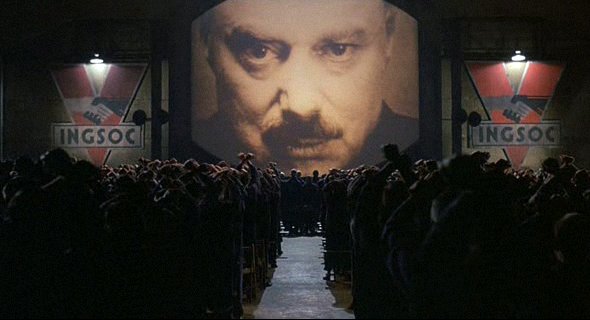
1984-movie-big-brother

The 1984 film adaptation of 1984.  I cannot embed this video, but you may watch it in very high quality and in full at Google Video here.

The film was actually shot in the industrial ruins of England during the same time period of the events depicted.  It’s a very powerful little movie made at a time when the Brits still made such movies.  Note the propaganda film being shown during the opening “two minutes hate” sequence.  The first minute of it sure looks familiar.  Authoritarianism of the left and authoritarianism of the right end up in much the same place.

After the jump, the 1954 BBC production of the novel, if you’d prefer something more vintage.

Continue reading