
David Staynes of the University of Ottawa in an audio interview discussing Frye, evaluative criticism, John Metcalf, and the best Canadian novels here.
David Staynes of the University of Ottawa in an audio interview discussing Frye, evaluative criticism, John Metcalf, and the best Canadian novels here.
httpv://www.youtube.com/watch?v=raT433AMiV8
Inspired by Stacey Clemence: a selection of songs from Cake, Pavement, and Beck that capture the eccentric spirit of the West coast music scene of the 1990s, and feature an agreeably quirky amalgam of guitar hero and bohemian sensibility. What they also have in common are irresistible sing-along choruses.
First up, the cuddly, the adorable, Cake, with “Shadow Stabbing”, a nifty little song about the claustrophobia of writing. Above is a fan-produced video, and Cake seems to inspire a lot of those.
httpv://www.youtube.com/watch?v=_Z8AddFYCnA
When Peter Cook died in 1995, John Cleese said of him that while he needed three hours to write a three minute sketch, Cook could do it in three minutes. And that, Cleese concluded, is the definition of genius: the ability to do it in real time.
Above is a clip from the lovely little English comedy from swinging 1967, Bedazzled, in which Cook, as Satan, tries to make a Faustian bargain with the hapless Stanley Moon, played by Dudley Moore. And, in making the argument, he illustrates the principle that it is better to reign in hell than serve in heaven.
My Frye Google Alert alerted me to a blog entry that reads in part, “this reminds me of something one of the more learned people Canada has ever produced, Northrop Frye, once wrote: education doesn’t make bad people good; it makes them more dangerous.”
Thanks to Bob Denham we have the actual quote from “Wisdom and Knowledge“: “Education makes a bad man more dangerous; it does not make him a better man.” (CW 5, 308)
httpv://www.youtube.com/watch?v=EXjY6w1KQMo
On this date in 1749 Handel’s Music for the Royal Fireworks was first performed in London.
The performance here is on period instruments. Part 2 after the jump.
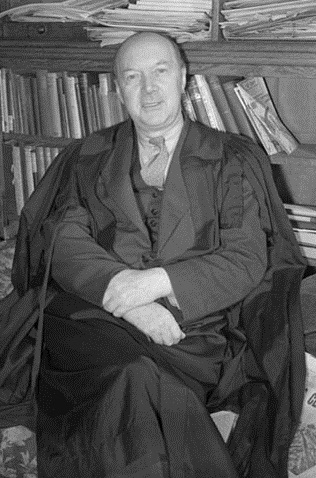
Pratt in 1944
On this date E. J. Pratt died (1882 – 1964).
Frye in “Ned Pratt: The Personal Legend,” published in the summer 1964 issue of Canadian Literature to commemorate Pratt’s death:
In my fourth year as an undergraduate I was editor of the college magazine, and had to administer a prize of ten dollars for the best poem contributed. The poems came in, and I took them to Ned. Ned didn’t recommend an award. What he did was put his finger on one poem and say, “Now this one — it has some feeling, some sensitivity, some sense of structure. But — well, damn it, it isn’t worth money.” I have never found a profounder insight into literary values, and I was lucky to have it so early. As a graduate student I was his assistant when he became the first editor of Canadian Poetry Magazine. I am not saying that what was printed in those opening issues was imperishable, but it was certainly the best of what we got. What impressed me was the number of people (it was the Depression, and the magazine paid a dollar or two) who tried to get themselves or their friends in by assuming Ned was a soft touch. In some ways he was, but he was not compromising the standards of poetry to be so: poetry was something he took too seriously. And, as I realized more clearly later, friendship was also something he took too seriously to compromise. People who thought him a soft touch were never his friends. He could be impulsively, even quixotically, generous to bums and down-and-outs, and I think I understand why. His good will was not benevolence, not a matter of being a sixty-year-old smiling public man. It was rather an enthusiasm that one was alive, rooted in a sense of childlike wonder at human existence and the variety of personality. This feeling was so genuine and so deep in him that I think he felt rather guilty when approached by someone towards whom he was actually indifferent. (CW 21, 327-28)

Oscar Wilde, one of Frye’s favorite critics, observes in The Critic as Artist, one of Frye’s favorite critical works, “Yes, the public is wonderfully tolerant. It forgives everything except genius.”
Great quip. Except of course that it can be proven wrong, as demonstrated yet again this year by Moncton’s Frye Festival. Every genius should be so fortunate to be so warmly and generously embraced by the hometown crowd, year in and year out. The most artistic of critics, Frye would no doubt have loved the fact that the festival held in his honor is a celebration of the arts first and foremost. The good people of Moncton have not only done it again but done it right.
Features in the Moncton Times & Transcript by local high school students here, here and here.
httpv://www.youtube.com/watch?v=aXb2a0WQek4
Today is the great Ella Fitzgerald‘s birthday (1917 – 1996).
One sample won’t do it. Above is her 1956 version of “Blue Moon,” and it proves a point: when Ella sings the most familiar of standards, you hear it like it’s the first time. That voice. Always that voice.
After the jump, some rare footage and live performances. And, yes, of course, a couple of duets with Louis Armstrong.

It’s no secret that the “traditional news media” are in decline — viewership and readership are down sharply, and, as a generational issue, Armageddon lies dead ahead: the fact is that a large and growing number of people under the age of 30 don’t consult traditional media outlets at all.
The New York Times is the self-declared “paper of record,” and it is, as the right loves to point out, the supposed standard bearer of a supposed “liberal elite”. And yet the Times is increasingly difficult to engage as a top-down authority in a world where news reporting is no longer merely a matter of professionals trained to provide the public with a healthy high-fibre diet of vetted stories and opinion. There are real reasons for this, most of them editorial. The “balance” that journalism is supposed to provide on stories of the day has devolved into ideological warfare in which, if X says one thing, then what Y says in response — no matter how crazy or irresponsible or demonstrably, factually wrong — is fair comment and deserving of equal consideration. Fact-checking is secondary. The passive reporting of what gets said is primary. And the New York Times has only added to the problem in recent years when it should in fact have been combating it on all fronts.
The complicity of the Times in the lead up to the invasion of Iraq is an excellent place to start, and characterizing it requires just one name, Judith Miller, who took insider-access journalism to a disastrous history altering low. In one infamous instance, Dick Cheney’s office provided Miller with unreliable intelligence pertaining to Saddam Hussein’s supposed effort to produce nuclear weapons. Miller duly published it in the Times on 7 September 2002, and Cheney then cited it the next day on Meet the Press as independent confirmation. In this way a dubious leak from an anonymous self-serving source became news in the paper of record, which effectively legitimatized it. It’s no wonder that progressive bloggers disdainfully refer to Washington insiders (whether politicians or journalists) as Villagers. Miller, of course, was also subsequently implicated in the crazy Rube Goldberg machinations by which Cheney’s office outed CIA agent Valerie Plame as political payback to her husband, Joseph Wilson, for his effort to debunk these same shoddy allegations circulating out of Cheney’s office.
The Times has never found its footing since the awfulness of the Miller affair and apparently still can’t make amends. Eight years ago it was willing to publish bogus stories on non-existent weapons of mass destruction in Iraq, but today can’t in its news pages bring itself to call the abuse the Bush administration inflicted upon detainees “torture“. It prefers instead placebos like “harsh” or “enhanced interrogation,” despite the fact that practices like waterboarding (”simulated drowning” in NYTspeak) are recognized in international law as torture and are therefore prosecutable as war crimes. Not to call them war crimes is to give war criminals credible cover for their actions: “Some say waterboarding is torture, some say it isn’t. It’s all debatable.” But that is not the case. Waterboarding is torture. It is a war crime. Those who are responsible for it should be prosecuted and punished.
If only it ended there. But last year the Times hired a conservative columnist to replace Republican party operative Bill Kristol, the 29 year old Ross Douthat, who, judging by his mediocrity and meteoric rise, is a familiar example of the Peter Principle for the privileged and well-connected. Week after week Douthat publishes columns that are a journalistic embarrassment for their intellectual shallowness and occasional incomprehensibility. All are arguably notable for their ideology driven dishonesty. What Douthat produces seems designed well in advance to mislead though omission, commission and casuistry.
httpv://www.youtube.com/watch?v=uTGog78pzp4
“No More,” from the album Woke Myself Up
New Brunswick native, Julie Doiron, who performed this past week at the Frye Festival. Visit her website here.
A poignant homemade video, “Me and My Friend,” after the jump.