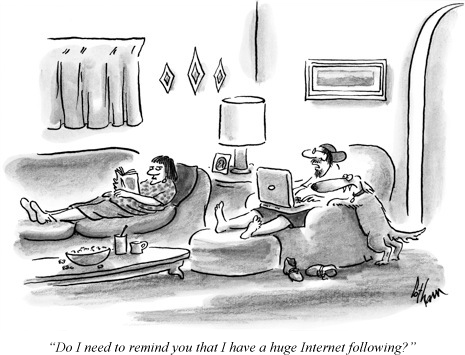
The first biographical nugget about Frye I ever knew about was probably his status as a youthful typing champion — maybe not all that surprising for a brilliant young scholar-to-be who also played the piano. But the first biographical detail that ever caught my attention was his love of The New Yorker. It must be because I’d discovered the magazine for myself and had already developed a sort of suburban-teen / older-woman crush on it. It’s true that The New Yorker was not then the titan it had once been and has probably only diminished in influence since. (Although it continues to have a natural affinity for Canadian-based intellect and talent: Alice Munro has published in the magazine for more than 30 years, and Malcolm Gladwell and Adam Gopnik have become stars in their own right under bylines there.) I continue to treasure this somewhat incongruous biographical factoid because there are days that I look at the blog and hope — however modestly, however faintly — that we at least strive to approximate the mood and tone of The New Yorker at its best: intelligent, well-read, engaged in the world as it is found while aspiring to improve it, and to do so with a knowing humor that is always pertinent to everything else we intend to do.
John Ayre’s biography has a few mentions of Frye’s affection for the magazine in his younger years, and observes of Frye’s impatience to receive back issues by mail during his 1936 stay at Oxford:
Given Frye’s seemingly bottomless taste for estoteric works, this voracious desire for copies of America’s quintessential upper-middle-class weekly with its cartoons and satire by Thurber and White appeared mysterious. But within the context of his misery at Oxford, it represented a life-line to an urbane North American perspective which Frye desperately needed. (133)
During a subsequent trip to Italy with Helen and Mike Joseph referred to in a previous post by Bob Denham, Frye likewise retreats at one point to “bury himself in the ten copies of The New Yorker he brought along” (153).
To be surprised by this is perhaps like being surprised by (as Joe Adamson, Borat-like, cleverly puts it) “sexy Frye”. It is always gratifying to be reassured that Frye was not a plaster saint, that he was fully aware of the world and the way it unfurls and rolls up its passing fancies. Frye’s occasional and fleeting references to phenomena like the punk rock of the late 70s and early 80s retain the freshness of their immediate context that many contemporary cultural critics cannot adequately capture. Those references don’t date; they responsibly characterize the temper of the time in a way only a real understanding of them could. That is, not too much emphasis, but rendered with a casualness that appreciates both that it is happening and that it too is part of a much larger pattern we are always struggling to become aware of — like (to refer to an analogy Frye uses on at least a couple of occasions) coral suddenly endowed with a vision of the reef of which they are a part. It’s as though Frye’s love of music always rendered him pitch perfect when it comes to what might otherwise be regarded as cultural ephemera. As individuals — and even as organized masses — we leave little of anything behind, however much urgency we invest in it. But that little seems to be more than enough if we are willing to see the world in a grain of sand.
And so Frye’s youthful love of The New Yorker contradicts any assumption that he was an abstracted intellectual interested only in ideal forms. One of my first profs gave props to Frye as a genius while suggesting that he cannot deal with the unique work of literature that is actually there for us to read. This couldn’t be further from the truth. Frye never retreats from this world; like the literature he loved so much, he engages the world to confront it, to stir us into awareness that it is a terrible place but that it never need be, to remind us that the worst — like the best — returns to laughter.