Author Archives: Michael Happy

Today in the Frye Diaries, 31 August

RosieTheRiveter

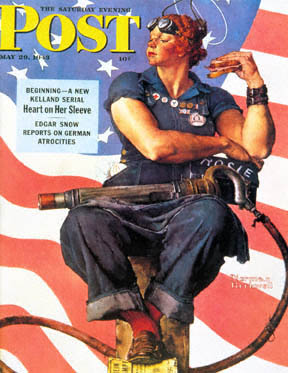
1942: Frye reveals that he’s a man of his time when it comes to women in wartime. He was clearly not yet familiar with this iconic figure, Rosie the Riveter, pictured above.

[90] Speaking of war, I sometimes feel that women are bad for morale: they go in for catastrophe, funerals & oracles. They’re the sex of Cassandra, and they’re extremely short on humor. They hate obscenity, an essential part of humor, and the female magazines never go in for it. Cartoons, jokes, breezy comic stories, have little place in the Ladies Home Journal. It isn’t just mediocrity: the male magazines for mediocrities always have humor: but what the average woman wants is something maudlin to attach her complex of self-pity and I-get-left-at-home and my-work-is-never-done and nobody-appreciates-it-anyway to. There’s something morbid about the domestic mind which weeps at weddings and gets ecstatic over calamities. During the war they keep making woo-woo noises prophesying large drafts & taxes with no we’ll-get-along-somehow reserve. Partly of course because they’re not in it. If people only believed in immortality & a world of spiritual values! But it might only make the war more ferocious.

1950: Frye’s account of the “Frye is God” lore that was then popular.

[585]… There was also a letter from Irving attached to his new essay for the Americans [it is not clear which paper Frye is referring to here]. A story in it about a freshman coming to Victoria to take an R.K. course from Professor Frye. When he begins he believes in God: when he gets to Christmas he believes in Frye’s God: when he comes to the end of the year he believes Frye is God. As a matter of fact I’ve known for some time that undergraduates used to refer to me casaually as “God” in their conversations. It’s a strain to live up to that, & doubtless of some theological interest to know that God gets a hell of a dose of hay fever every year at this time: maybe that’s why so many wars start in August & September.

Coming Soon: Epiphanies

angel

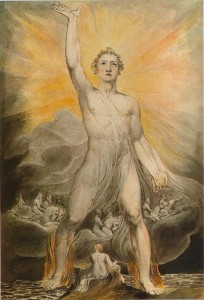
Bob Denham has prepared a remarkable collection of Frye’s epiphanies from a number of sources, including his notebooks, diaries, and various interviews.  It is bracing reading.  We’ll be posting it in its entirety tomorrow.  My guess is that this will preoccupy the thoughts of many who read it.  We genuinely hope to receive your observations, in whatever form they come.  This is undoubtedly a motherlode.

Today in the Frye Diaries, 30 August

Flag

1942: The draft comes close to home, worrying Frye’s brother-in-law, Roy Kemp:

[89] Out to Fulton Ave., finding Roy [Kemp] very gloomy about the draft. The draft is getting rather horrible, with this hypocritical pretence that they’re only calling “single” men, including all men married since 1940 who now have businesses & small children coming along. Our three noisy female neighbors are getting it: one husband in the army, one in the air force, one category E with a game knee expecting to be examined and shoved in.

1950: One last day tour with Helen and Ruth Jenking as the summer comes to an end:

[584] We drove around Portland, which is a largish town about Lowell’s size & evidently attempts to dedicate itself to Longfellow, but looks tough. We make a half-hearted attempt to find the local museum — Ruth is very conscientious about such things but we had no desire whatever to be instructed by Portland. So we said goodbye to Ruth in a very hole-in-the-corner sort of way, as she was wriggling out of the wrong end of a one-way street. We have had some wonderful times with Ruth this summer, & hated to see them end. Helen has a theory that groups of three don’t work out properly, but Ruth has destroyed that theory.

Tomorrow: women during wartime; “Frye is God”

Today in the Frye Diaries, 29 August

keny0706 

1942:

[88] Read Oscar Levant’s Smattering of Ignorance. Gossipy and malicious: quite good on Hollywood’s bag-of-tricks approach to sound tracks. If a producer gets less than tutti he feels gypped. Conventional “sweep” for opening: i.e. harp glissando, ascending-scale violin passages & woodwinds, ff [fortissimo], then cymbals crash on first beat, then grandiose tuttis.

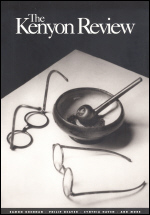
1950: A banner day: Frye has a big breakthrough on the paper that will eventually be published as “A Conspectus of  Dramatic Genres,” in The Kenyon Review 13 (Winter 1951).  This paper — along with “The Archetypes of Literature” also written during this same summer — is one of the foundations of what would later emerge as Anatomy of Criticism (1957).

[581] Today I was still very groggy & still didn’t feel I could go in swimming. One good thing is that my Kenyon Review paper has suddenly started to clear up. It’s clearing up so damn fast I can hardly keep up with it. Part One has boiled down perfectly out of what I had & Part Two came along beautifully this afternoon: it meant cutting out a lot of stuff, but the net result is one of the most concentrated & best integrated articles I’ve ever produced. No splutter, no gargle, no leers, no attempt to fasten pedantic teeth in the arse of somebody else. Nothing but dry fact and obvious truth, expressed with overwhelming concentration and great simplicity. In short, an article to rank with the Argument of Comedy and the Forms of Prose Fiction, only on an even bigger subject.

Tomorrow: the wartime draft blows close to home; “A Conspectus of Dramatic Genres” all but complete, an end of summer tour

Helen Kemp: “Frygian”

kempfrye

A note from Margaret Burgess may resolve the issue of the adjectival form of “Frye”:

 I don’t know how much Frye would care about which variant is used, but it is perhaps worth noting for the record that the term appears in the Correspondence, where Helen, writing from London on 12 October 1934, quips: “I have quite a stock of Frygian witticisms up my sleeve to chuckle over at odd moments on the ‘bus and walking down streets, and even in lectures when they’re dull” (NFHK, 1:344). Although there is obviously no way of knowing, one might speculate as to whether she thought up the term on her own, or whether it might possibly have been coined at some earlier time by Frye himself.

Today in the Frye Diaries, 28 August

492PX-~1

 1942: Frye and his drinking buddy George Beattie join Helen and Ruth Jenking for a night of “pounding hell out of” Mozart:

[87] Discovered something called Allergitabs, which make me feel funny but seem to work. Picked up that souse George Beattie at the pub and then went to a kosher place on College & Spadina, George making love furiously to Helen all the way. Then to Ruth Jenking’s where we pounded hell out of a couple of Mozart fantasias — amazing things he wrote in 1791 for music boxes, his last year when he was picking up anything he could get in the way of a commission.

1950: Hay fever, the formal causes of literature, and beauty:

[580] Well, today the sea breezes blew ragweed at me all day long, & I had, quite simply, one hell of a time. I didn’t feel able to go swimming — I knew that if I tried I’d start sneezing my fool head off. So I stayed on the verandah or on the beach and scribbled at my paper. A young girl here about eighteen…kept playing around me with a dog. She wasn’t especially pretty or intelligent looking, but her body — she was in a bathing suit — had that extraordinarily beautiful feeling of youth & health about it, & with this lovely & nearly naked figure hovering in my line of vision I had some difficulty concentrating on the formal causes of literature.

Tomorrow: hay fever notwithstanding, a breakthrough on the formal causes of literature

Video: “A Tribute to Northrop Frye”

This is pretty funny. This video claims to be part of a high school student seminar on chapter 3 of The Educated Imagination, “Giants in Time.”  As far as I can tell, it’s really just three guys looking for a reason to perform a card trick:

httpv://www.youtube.com/watch?v=8vk5cxtTcTw

Now, to be fair, the boys themselves have this to say about the video:

This was a video made for a seminar analyzing Chapter 3: Giants In Time, of Northrop Frye’s “The Educated Imagination.”
We linked his concept of poetry with a “voodoo” magic illusion for the visual aspect of our seminar.
Enjoy!
– Andre, Jay, and Josh.

I’m just psyched that high school kids are still reading The Educated Imagination.  Although I’d really have to hear the rest of their presentation on the “voodoo magic” qualities of “Giants in Time.”

Today in the Frye Diaries, 27 August

Dieppe

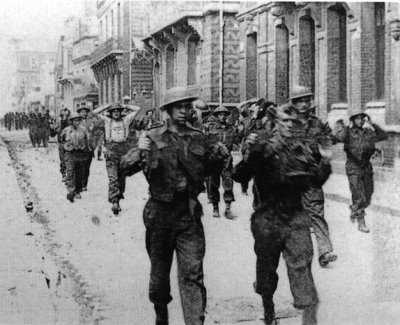
 1942: The recent Dieppe raid, which was soon to be an acknowledged disaster, continues to preoccupy Frye (Canadian prisoners pictured above).

[84] I resolved today to (1.) keep up my diary (2.) read all the books I own, before reading much else (3.) write Blake (4.) practise Byrd. Saw Beverley Burwell, who looks taller & older & tells me Jerry Riddell has gone to Ottawa for [censored]. He’s pessimistic about the war. Bickersteth’s letters home are mimeographed & circulated & contain many vicious comments about the War Office: full of antiquated crocks hanging on to their salaries & avoiding being pensioned off on various pleas of emergency. He seems to feel that the German account of Dieppe as a foozled invasion attempt was correct: I’m not sure; it’s too symmetical. Of course if it proved only that Canadians are not cowards it didn’t prove much.

1950: A day trip to Salisbury Beach, Mass., with Frye’s U of T colleague, Ruth Jenking. 

[576] I find the Newburyport turnpike a bit dull, as a road, but Ruth talked easily, she was so relieved to get through with Harvard. The one thing she got from her summer is some understanding of [John C.] Pope’s study of The Rhythm of Beowulf, which, incidentally appeared in 1942, the year of my Music and Poetry article, and if I reprint my essays I may say that this article is a footnote to Pope’s book. Or, in the words of the oracular cliche, I may not. Anyway, the proper way to read Old English is crystal clear to her now, and as it’s a revelation in itself she feels it almost makes up for a very dull summer.

Tomorrow: the formal causes of literature and a young woman in a bathing suit

Now with YouTube!

httpv://www.youtube.com/watch?v=jR0588DtHJA

We now have YouTube-embedding capacity!  Of course, we don’t actually have any relevant video. But we do have the capacity to embed video, so we just had to come up with something.  Given the Northrop Frye-Thomas Pynchon nexus established last week here and here, this video might qualify as marginally germane.  Sure, it’s post-modern enough, but is it also Menippean satire?