Author Archives: Michael Happy

Bob Denham: “Pity the Northrop Frye Scholar”? Anatomy of Criticism Fifty Years After

fp-logo

Bob Denham’s talk to the Frye Festival in April 2007 has been added to the Festival Archive in the journal.  It can be linked directly here.

A sample:

In his foreword to the reissue of the Anatomy in 2000 Harold Bloom remarks that he is “not so fond of the Anatomy now” as he was when he reviewed it forty‑three years earlier (vii).  Bloom’s ambivalence springs from his conviction that there is no place in Frye’s myth of concern for a theory of the anxiety of influence, Frye’s view of influence being a matter of “temperament and circumstances” (vii)  Bloom’s foreword, however, is devoted chiefly, not to the Anatomy, but to his own anxieties about Frye’s influence, presented in the context of his well-known disquiet about what he calls the School of Resentment––the various forms of “cultural criticism” that take their cues from identity politics.  In the 1950s, Bloom says, Frye provided an alternative to the New Criticism, especially Eliot’s High Church variety, but today he is powerless to free us from the critical wilderness.  Because Frye saw literature as a “benignly cooperative enterprise,” he is of little help with its agonistic traditions.  His schematisms will fall away: what will remain is the rhapsodic quality of his criticism.  In the extraordinary proliferation of texts today, according to Bloom, Frye will provide “little comfort and assistance”: if he is to afford any sustenance, it will be outside the universities.  Still, Bloom believes that Frye’s criticism will survive not because of the system outlined in the Anatomy, but “because it is serious, spiritual, and comprehensive” (xi).
A. Y. Jackson

AY-Jackson-Wilderness-Deese-Bay-L

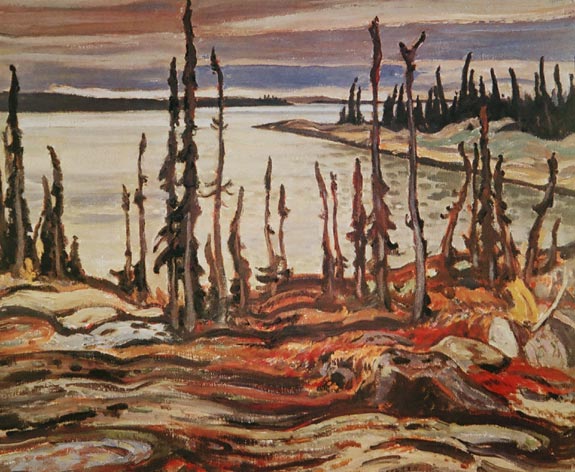
Wilderness, Deese Bay

On this date in 1974 A. Y. Jackson died.

Frye in “Culture and the National Will” (regarding the way in which artists — literary ones included — create the national landscape):

If you look at Mr. Jackson’s paintings, you will see a most impressive pictorial survey of Canada: pictures of Georgian Bay and Lake Superior, pictures of the Quebec Laurentians, pictures of Great Bear Lake and the Mackenzie River.  What you will not see is a typically Canadian landscape: no such place exists. (CW, 12, 275)

Vintage CBC report on the Group of Seven and the Rheostatics after the jump.

Continue reading

Easter

800px-Caravaggio_incredulity

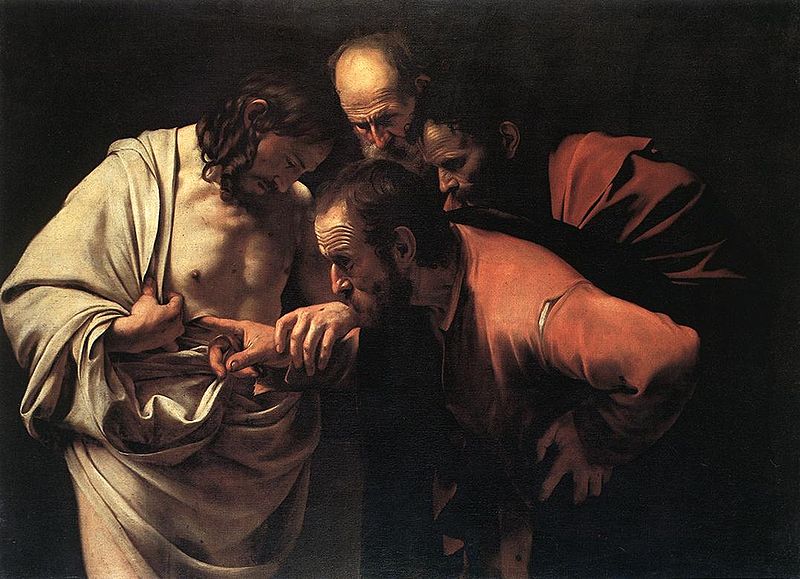
Caravaggio’s The Incredulity of Saint Thomas, 1601

From the Late Notebooks:

When Jesus says “I am the way” [John 14:6] time stops.  There is no journey through unknown country: all the disciples have to do is walk through the open door (another “I am” metaphor [John 10:9]) of the body in front of them).  That is, I think, impossible before the Resurrection.  Perhaps everything that happens in the gospels is not an event but a ticket to a post-Resurrection performance.  Except that the spiritual reality is not so much future as an expansion of the imaginative possibilities of the present.  The myth confronts: it doesn’t prophesy in the sense of foretelling.  (CW, 5, 159)

Jesus is not “a” historical figure: he’s dropped into history as an egg is into boiling water, as I said [par. 301], and essentially “the” historical Jesus is the crucified Jesus.  One can understand why the Gnostics tried to insist that the crucifixion was an illusion, but nobody can buy that now.  The pre-Easter Jesus answers the question: ‘Can a revolt against Roman power succeed?”

The answer is no, and the pre-Easter Jesus sums up the history of Israel, which is a history of “historical” failure. (CW, 5, 170)

The Resurrection, then, is the marriage of a soul & body which forms the spiritual body.  The body part of this marriage is female: the empty tomb is recognized solely by women, except perhaps for that fool who stuck Peter into John’s account [20:1-10]. (Perhaps the “and Peter” of Mark [16:7] was stuck in too.)  The fact that Jesus took on flesh in the Virgin’s womb has certainly been dinned into Christian ears often enough; but the fact that he took on flesh in the womb of the tomb at the Resurrection, and that there’s a female principle incorporated in the spiritual body, seems to have been strangled.  The real tomb of Christ was the male-guarded church.  (CW, 5, 327)

The historical Jesus is a concealed though essential element in the Gospels: if the Gospels’ writers had simply made up the Jesus story they would still be superb works of literature, but of course they wouldn’t be gospels.  The myth is what they literally are, though: they don’t present Jesus historically.  Historically, Jesus is a man until the Resurrection, when he becomes an element in everyone, implying that no one can be “saved” (meaning the indefinite persistence of something like an ego in something like a time and space) outside or before Jesus.  Presented as a myth in the eternal present, this doctrine takes on a more charitable appearance.  The Word and Spirit in man then coincide into something that has its being in God (as God has his being in it) to such an extent that the question of belief in “a” God doesn’t arise.  (CW, 6, 671)

From CBC radio “Rewind”, various Easter broadcasts dating back to the 1940s, including Frye in 1973 on Easter myths and symbols (beginning at the 24 minute mark).

Punked . . .

arg-dancing-april-fool-pink-on-black-sm-url

. . . by the great Bob Denham.

I woke up early this morning to the following email (whose subject is “Delirious”) addressed to me and Michael Dolzani.

I fell for it.  Completely.  Unreservedly.  With thrilled anticipation!  Well played, Master.

Getting involved in this blog has meant that I’ve had to retrieve my Frye files from my garage, where I’d mothballed them.  Well, looking through some files today I discovered what looks to be a corrected typescript for the “Third Book.”  It’s more or less what Norrie projected, as best this can be determined from the “Third Book” Notebooks.  It appears to have been typed by Jane.  In any case it’s not one of Norrie’s typical marginless typescripts.  I thought I had a pretty good handle on what I’d copied from the files in Vic, and how this one got lost in the cracks rather baffles me.  At the top of the first page Norrie wrote in pencil “The Symbolic Universe.”  I’ve written Alvin to see if he’s up to having still another volume in the CW.  I’m currently scanning it to disk (it’s 327 pp. in its current form).  The book has (guess what) eight chapters, two each devoted to Eros, Adonis, Thanatos, and Logos.  I’m naturally ecstatic.  Guess this will require some revisions to all those statements we’ve put out there about the never completed Third Book.  Anyway, I wanted the Michaels to be the first to know.  I’ve attached some sample pages.

Yrs,
Bob

[Attachment: SymbolicUniverse.doc]

John Donne

Donne-shroud

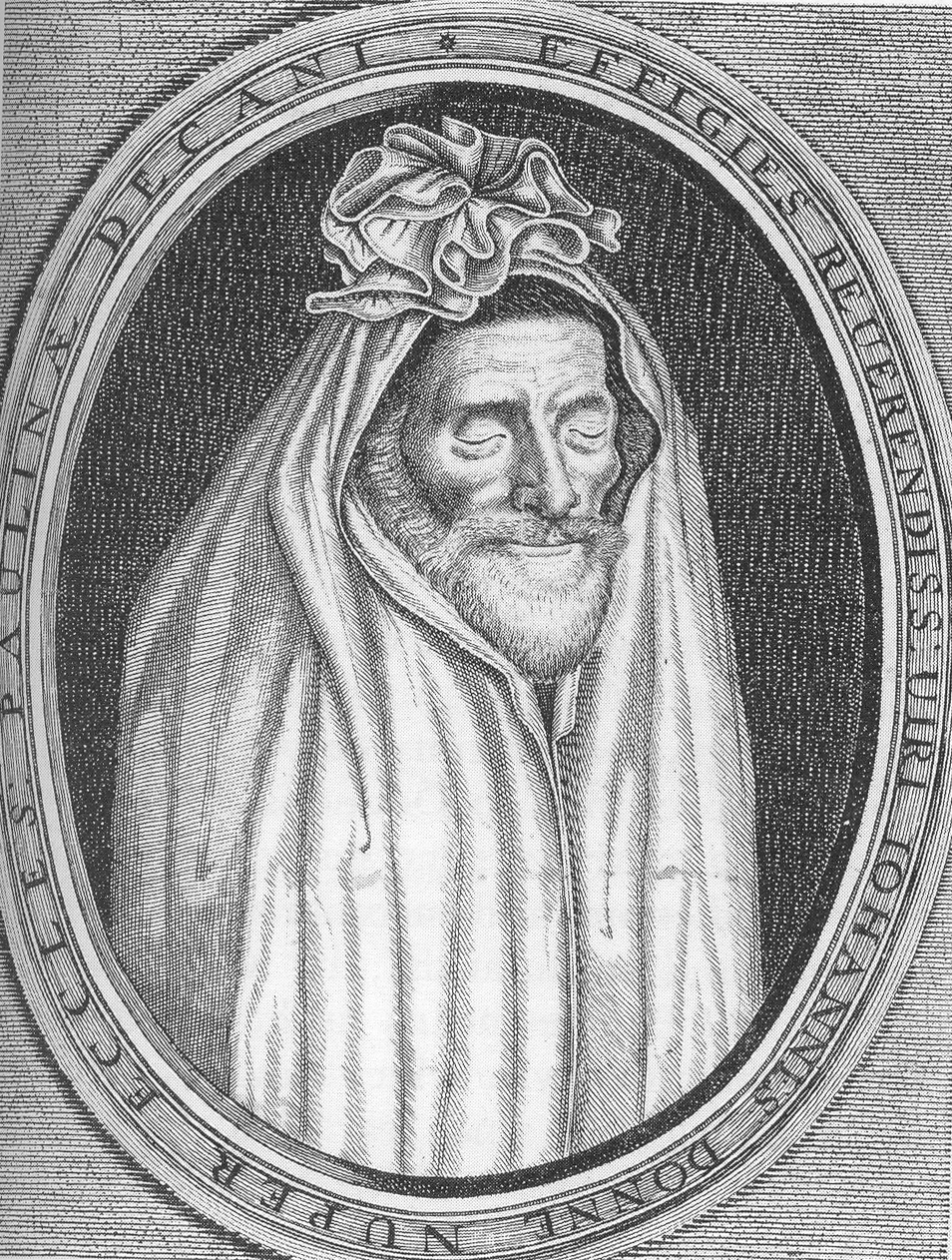
The portrait commissioned by Donne in his shroud during his last months

On this date in 1631 John Donne died at age 59.

Holy Sonnet X

Death be not proud, though some have callèd thee
Mighty and dreadfull, for, thou art not so,
For, those, whom thou think’st, thou dost overthrow,
Die not, poore death, nor yet canst thou kill me.
From rest and sleepe, which but thy pictures bee,
Much pleasure, then from thee, much more must flow,
And soonest our best men with thee doe goe,
Rest of their bones, and soules deliverie.
Thou art slave to Fate, Chance, kings, and desperate men,
And dost with poyson, warre, and sicknesse dwell,
And poppie, or charmes can make us sleepe as well,
And better than thy stroake; why swell’st thou then;
One short sleepe past, wee wake eternally,
And death shall be no more, death thou shalt die.

Frye on Donne in Words with Power:

In The Great Code I used the word “interpenetration” (167-8/189) tp describe this fluidity of personality in its complete form.  The word “love” means perhaps too many things in English and for many has an oversentimental sound, but it seems impossible to dissociate the conceptions of spiritual authority of love. The capacity to merge with another person’s being without violating it seems to be at the centre of love, just as the will to dominate one conscious soul-will externally by another is the centre of all tyranny and hatred.  John Donne uses a beautiful figure in this connection based on the metaphor of an individual life as a book.  The spiritual world, he says, is a library “where all books lie open together.” (CW, 26, 117-18)

Emma Thompson and Holy Sonnet X in Mike Nichols’s film adaptation of Wit after the jump.

Continue reading

Joseph Haydn

httpv://www.youtube.com/watch?v=Nk4Fk9jMujs

The Seasons, “Winter”

Today is Haydn‘s birthday (1732 – 1809).

Frye in Notebook 18:

Haydn is a genius of the idyllic unfallen world: it can’t be just accident that the Creation & the Seasons sum him up.  Incidentally, the spinning song in the latter is amazingly sinister: the spinning wheel of the fates. The words superficially cosy & domestic, have Vala overtones he caught, though there’s no passion or fatality as in Schubert’s Goethe song. (CW, 23, 296)