httpv://www.youtube.com/watch?v=wyOf_L4cNHc
Glenn Gould, Piano Concerto No. 7 in G Minor
httpv://www.youtube.com/watch?v=wyOf_L4cNHc
Glenn Gould, Piano Concerto No. 7 in G Minor
More from the great Charlie Brooker: “Nobody knows anything.”
httpv://www.youtube.com/watch?v=dm4GiyyVKQQ

As we said yesterday, we are off to work on our infrastructure, primarily in the Denham Library whose remarkable collection needs some serious attention, including new acquisitions and standardization of format, not to mention preparation for what will eventually prove to be a massive audio/video collection, some of them genuine rarities not widely seen or heard before. You’ll be thrilled, once we’ve pulled it all together. A first batch may appear in the next couple of weeks, as soon as we get them digitized. You’ll see a second truly overwhelming addition to the collection by summer.
In the meantime, we have added a new Widget to the Menu Column to the right: A calendar for each month we’ve been publishing with all the days of the month live linked to the posts of that particular day. Hit the link for the day in question and the posts will come up in the reverse order they appeared. Add to this our Search function at very top of our Menu Column and the Categories function at the very bottom, and you should be able to find yourself targeting posts by any topic, key word, or designated category that catches you interest, as well as their various threads via live links.
Given that we’ve put up more than 400 posts at this point, this may be a good opportunity for many of you new and even regular readers to explore our offerings in any way that makes most sense to you.
So be sure to check out that new Calendar Widget just to your right.
We’ve been around just a little over five months and have put up well over 400 posts.
However, most of that effort has fallen to just a handful of people, and, given the particularly heavy demands this semester upon the daily administrators, this may be a good time to step back a little to let our new byline correspondents and our guest bloggers take the lead.
Since starting out last August, we’ve put up posts at the average rate of about three a day. We’ve also added (besides Joe Adamson and me) 10 byline correspondents, as well as another handful of regular guest bloggers — not to mention an online Frye journal and the truly remarkable (and always expanding) Denham Library. We’re pleased to say that the comments we’ve received slightly outpace the posts we’ve put up so far. We’re therefore curious to know what the blog might look like if we let our occasional contributors become the main source of new material.
In the meantime, we’re working very hard behind the scenes to add an extensive audio/visual Frye collection to the library, which will take some time pull together and convert into digital format. In fact, the project as a whole will probably stretch out into the summer. But, once this remarkable material is available, it will provide a new dimension to the resources already available. Beyond that, we are also planning to organize study and resource material for students and teachers alike. In other words, there’s still much more we intend to do.
We’re here. We’re for real. So while you may not see original posts from us on quite so regular a basis, we are hoping to see more of them from you.
httpv://www.youtube.com/watch?v=YtGSXMuWMR4
A superlative bit of meta-comedy that perfectly explains why mainstream news media are increasingly irrelevant.
Courtesy of the BBC — and YouTube.
The Educated Imagination was the first book by Frye I read, and it’s therefore always a touchstone for me. You never forget your first love. Meanwhile, Fearful Symmetry remains Frye’s most mind-blowing text, The Great Code his most challenging, and Words With Power his most expansive for practical critical purposes. But like many Frygians, I’m guessing, I regularly return to Anatomy of Criticism, and, it seems, almost involuntarily. Every once in awhile I find myself preoccupied by something from it that I seem to recall out of the blue. Thanks to an email exchange with Peter Yan and the cumulative effect of posts over the last week or so, I have been pondering an issue Frye briefly raises in Anatomy that gets relatively little attention (the exception perhaps being Bob Denham’s Northrop Frye and Critical Method): “demonic modulation.”
With demonic modulation Frye makes a much needed distinction between “the moral” and “the desirable”:
The moral and the desirable have many important and significant connections, but still morality, which comes to terms with experience and necessity, is one thing, and desire, which tries to escape from necessity, is quite another. Thus literature is as a rule less inflexible than morality, and it owes much of its status as a liberal art to that fact. The qualities that religion and morality call ribald, obscene, subversive, lewd and blasphemous have an essential place in literature but often they can achieve expression only through ingenious techniques of displacement. (AC 156)
How does demonic modulation manage this? By way of “the deliberate reversal of the customary moral associations of archetypes.” For example, in literature, whatever the current status of received moral standards,
a free and equal society may be symbolized by a band of robbers, pirates, or gypsies; or true love may be symbolized by the triumph of an adulterous liaison over marriage, as in most triangle comedy; by a homosexual passion (if it is true love that is celebrated in Virgil’s second eclogue) or an incestuous one, as in many Romantics. (AC 156-7)
A.C. Hamilton in Northrop Frye: Anatomy of his Criticism describes Anatomy, published in 1957, as very much a book of its time — so Frye’s reference to various forms of forbidden love as “modulations” must have been eyebrow-raising for many conventionally-minded readers. Frye does not call it that here, but what he is clearly talking about is literature’s unique ability to express primary concerns beyond the pervasive gravitational pull of secondary ones.
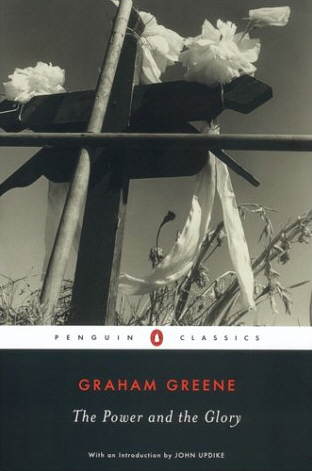
I’m pretty sure I can remember the first time I ever became aware of this in my own reading experience: Graham Green’s The Power and the Glory, which was an assigned text back when I was in the 11th grade. I remember struggling with the contradiction between Greene’s “whiskey priest”‘s all too human frailty and his compelling nature as a human being I felt I could love and identify with, despite his obvious failings. I’m also pretty sure that even though I wondered about it at the time, I was nevertheless grateful to accept that it was so. Literature was showing me something I otherwise couldn’t account for with any certainty; and within a year I read The Educated Imagination for the first time which articulated what I in some sense already knew but simply could not yet say.
Literature references ideology but does not promote it. Literature gives expression to primary concerns, most especially when they are contrary to the ideologies that readily suppress them. Desire may on occasion be moral, but the moral can never contain desire — and in the struggle between the moral as a secondary concern and desire as a primary one, desire always prevails. That, paraphrasing Wilde’s Lady Bracknell, is what fiction means.
httpv://www.youtube.com/watch?v=Mia9woisQZo
Today we are commemorating the 19th anniversary of Frye’s death on January 23rd, 1991. It is only fitting, therefore, that our regular Saturday night music video feature the work of the well-tempered critic’s favorite composer: Bach’s “Fugue in E Major”, The Well-Tempered Clavier, Book II.
“Death is a process, not a condition. A stone is not dead: when did it die?”
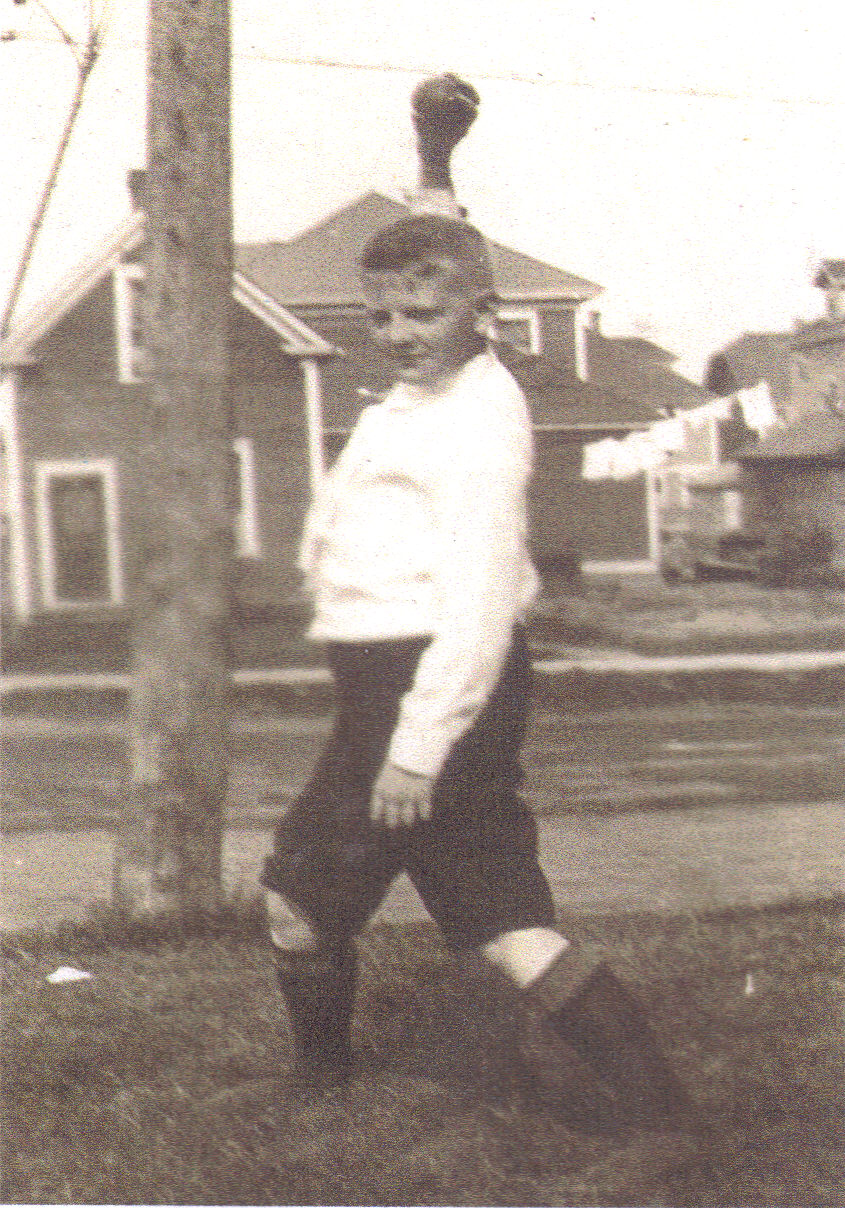
Norrie, aged 10, Pine Street, Moncton, New Brunswick
Northrop Frye: 14 July 1912 – 23 January 1991
“The twentieth century saw an amazing development of scholarship and criticism in the humanities, carried out by people who were more intelligent, better trained, had more languages, had a better sense of proportion, and were infinitely more accurate scholars and competent professional men than I. I had genius. No one else in the field known to me had quite that.”
Obituary, The New York Times.