Quotes of the Day: Wilde on Art

If with the literate I am
Impelled to try an epigram,
I never seek to take the credit;
We all assume that Oscar said it.
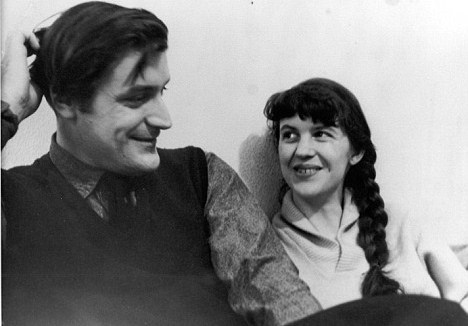
Dorothy Parker

Life imitates art far more than art imitates life.

Illusion is the first of all pleasures.

It is through art, and through art only, that we can realise our perfection.

No great artist ever sees things as they really are. If he did, he would cease to be an artist.

Art is the most intense mode of individualism that the world has known.

Man is least himself when he talks in his own person. Give him a mask, and he will tell you the truth.

If one cannot enjoy reading a book over and over again, there is no use in reading it at all.

The world is a stage, but the play is badly cast.

The critic has to educate the public; the artist has to educate the critic.

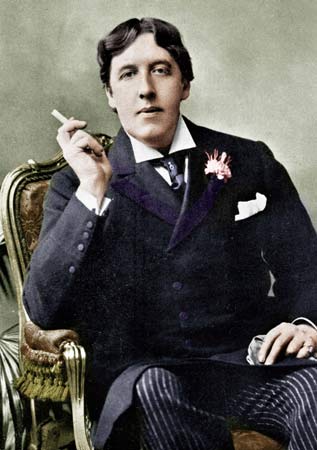
Oscar Wilde

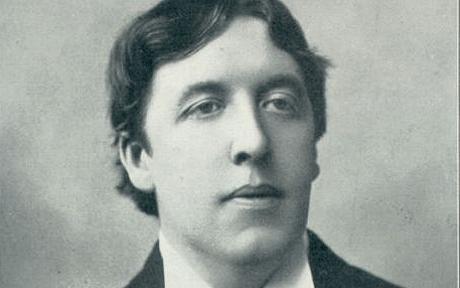
Today  is Oscar Wilde‘s birthday (1854-1900).

Frye was a great admirer of Wilde (see especially Creation and Recreation), and there are any number of quotes that could be cited today, but this one from The Secular Scripture will do:

The beginning of a new kind of criticism is marked by Oscar Wilde’s The Decay of Lying, which explains very lucidly that, as life has no shape and literature has, literature is throwing away its one distinctive quality when it tries to imitate life.  It follows for Wilde that what is called realism does not create but can only record things at a subcreative level:

“M. Zola sits down to give us a picture of the Second Empire.  Who cares for the Second Empire now?  It is out of date.  Life goes faster than Realism, but Romanticism is always in front of life.”

Wilde was clearly the herald of a new age in literature, which would take another century or so to penetrate the awareness of critics.  He was looking forward to a culture which would use mythical and romantic formulas in its literature with great explicitness, making once more the essential discovery about the human imagination, that it is always a form of “lying,” that is, turning away from the descriptive use of language and the correspondence form of truth.  (45-6)

TGIF: “What Happens When You Slow Down a Justin Bieber Song by 800%?”

httpv://www.youtube.com/watch?v=r2ozuCXpVJY

From Gawker:

Justin Bieber is very popular. Lots of people love her songs! One of Bieber’s most popular tunes is called “U Smile.” But what happens when one slows it down by 800%? Well, it becomes a haunting, 36-minute Enya-like thingy. Seriously.

“Her songs.”  Funny.  But the audio is, as unlikely as it sounds, the best stoner music probably since Pink Floyd’s “Echoes” — you know, side two (as it was then) of Meddle.  The magic can be heard here.

The actual song above.

An earlier post, “Lesbians Who Look Like Justin Bieber,” here.

Virgil

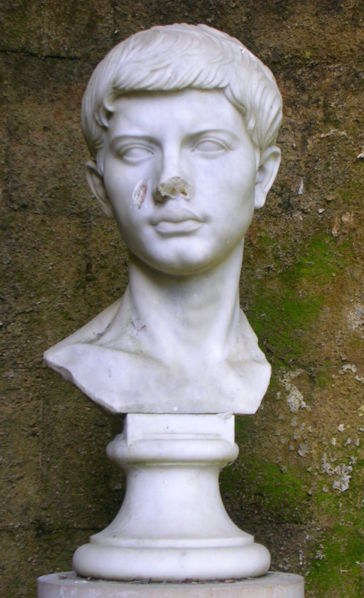
Today is Virgil‘s birthday (70 BCE-19 BCE).

Frye in The Secular Scripture:

This attitude [of identification between authors] has recently revived as a form of existential criticism.  Its method is brilliantly satirized in Borges’ story of Pierre Menard, whose life’s work it was to rewrite a couple of chapters of Don Quixote, not by copying them, but by total identification with Cervantes.  Borges quotes a passage from Cervantes and a passage from Menard which is identical with it to the letter, and urges us to see how much more historical resonance there is in the Menard copy.  The satire shows us clearly that nothing will get around the fact that writer and reader are different entities in time and space, that whenever we read anything, even a letter from a friend, we are translating it into something else.  Dante tells us that he could never have gone through hell and purgatory without the instruction of Virgil.  Virgil, many centuries later, when interviewed by Anatole France in Elysium, complained that Dante had totally misunderstood him.  Without going in quite the same direction that some critics have done, I think it is true that this is how the recreating of the literary tradition often has to proceed: through a process of absorption followed by misunderstanding, that is, establishing a new context.  Thus an alleged misunderstanding of Ovid produced a major development in medieval poetry, and some later romance is bound up with such phrases as “Gothic revival” and “Celtic twilight,” misunderstandings of earlier ages that never existed.  (162-3)

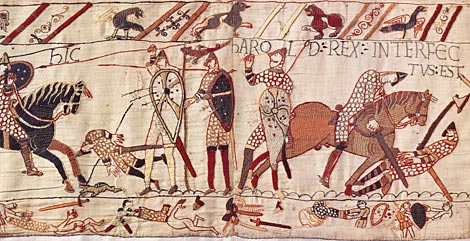
Battle of Hastings

Death of Harold (centre), Bayeux Tapestry

On this date in 1066 William the Conqueror defeated Harold II in the Battle of Hastings to become King of England.

Okay, yes, it’s a stretch — and the reference is only incidental — but I’ll use any excuse to cite Frye where he is most accessible on the unique authority of literature.  And it’s remarkable, isn’t it, how often we come across extraordinarily lucid passages like this one from The Educated Imagination:

We can understand though how the poet got his reputation as a kind of licensed liar.  The word poet itself means liar in some languages, and the words we use in literary criticism, fable, fiction, myth, have all come to mean something we can’t believe.  Some parents in Victorian times wouldn’t let their children read novels because they weren’t “true.”  But not many reasonable people today would deny that the poet is entitled to change whatever he likes when he uses a theme from history or real life.  The reason why was explained long ago by Aristotle.  The historian makes specific and particular statements as: “The battle of Hastings was fought in 1066.”  Consequently he’s judged by the truth or falsehood of what he says — either there was such a battle or there wasn’t, and if there was he’s got the date either right or wrong.  But the poet, Aristotle says, never makes any real statements at all, certainly no particular or specific ones.  The poet’s job is not to tell you what happened, but what happens: not what did take place, but the kind of thing that always takes place.  (35)

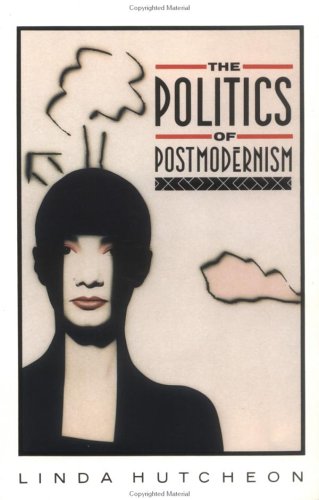
Linda Hutcheon Scholarship

University Professor and past president of the Modern Language Association of America, Linda Hutcheon, has just retired from the University of Toronto.  Professor Hutcheon is the most cited living Canadian scholar of literature, the only worthy successor to Northrop Frye. According to the citation index Publish or Perish, she has been cited 5,605 times in Google Books.  Her h-index, a formula based on how many books a scholar has produced as well as on citations, is 17, the same h-index as Marshall McLuhan or Salman Rushdie.

But, more than her publications, Linda has transformed the ethos of the academic units she works in by making all relations warmer and more human. The two words most associated with her professional presence among us are generosity and community. All her students can testify to her generosity. Since coming to U of T 1989 she has supervised 61 PhD theses!  She has served on another 61 thesis committees! Her example has taught all of us, her students and her colleagues alike, what the mentor-student relation can be.  Linda has also provided us with a wholly new model of what literary scholarship can be.  It does not have to be solitary. Research, publication, and teaching, she has taught us, are all collective enterprises.

Upon her retirement, in her honour the Department of English and the Centre for Comparative Literature at the University of Toronto have established a scholarship in Linda’s name to be awarded to an incoming PhD student in English or Comparative Literature working in the areas of contemporary literature, theory, or interdisciplinary approaches to literature. If you would like to donate to the Linda Hutcheon Scholarship Fund, it is possible to make an online contribution by visiting either the Comparative Literature (http://www.chass.utoronto.ca/complit/) or English web-sites (http://www.english.utoronto.ca/Page4.aspx) and following the links.

Adam Gopnik at Frye Festival Community Read

From Moncton’s Times & Transcript

Adam Gopnik to make appearance on Oct. 29 at city hall

A New York Times bestselling author will appear in Moncton later this month during the Frye Festival’s Fall Community Read.

Click to Enlarge
Click to Enlarge

Adam Gopnik, a writer for The New Yorker, will appear in the lobby of Moncton City Hall on Friday, Oct. 29 from 5 to 7 p.m.

The event will be followed by a reception with refreshments.

Born in Philadelphia but raised in Montreal, Gopnik left the familiarities of New York City in 1995 for the charm of Paris. His wife and their infant son went along, and for five years they tried to catch on to the quirks of French culture. Gopnik recorded his experiences, frustrations and delights in his “Paris Journal” for The New Yorker, which won him awards.

A collection of the Paris Journals was published in 2000 by Random House as “Paris to the Moon.”

“We encourage everyone to come discover this bestselling and award-winning author,” says Frye Festival executive director Danielle LeBlanc. “The way Gopnik relates the meeting of two cultures in Paris to the Moon fittingly reflects the realities of our daily lives here in Moncton.”

Those who want to read some of Gopnik’s work before the event can go to www.frye.ca.

A reading guide with information on the author and chapter summaries is also available on the website.

Admission to the event is “pay what you can,” with donations requested.

The Frye Festival’s Community Read series presents bilingual authors whose books are available in translation. The aim is to encourage dialogue between the linguistic communities by rallying them around one author and one book.